

Acoustic Insulation & Vibration Isolation in Qatar Hotels: Underlays, Pads & Standards
Ask a hotel general manager what drives the most guest complaints and the answer is rarely the food: it is noise. Voices from the next room, footsteps from the suite above, and the low structure-borne hum of a rooftop chiller transmitted through the concrete frame can undo a five-star interior fit-out. In Qatar's hospitality market, where guest expectations are set by international brands and reviews travel instantly, acoustic performance is not a luxury afterthought: it is a measurable engineering requirement, tested in numbers, verified at handover and audited by brand standards.
This guide explains the three types of noise that matter in hotels, the standards and ratings used to specify them, and the products that deliver results: acoustic underlays under floor finishes, resilient layers under screeds, and vibration isolation pads under equipment plinths in plant rooms.
The Three Types of Hotel Noise
1. Airborne sound: voices, televisions, music. It travels through walls and floors and is rated by sound reduction: Rw (weighted sound reduction index, BS EN ISO 717-1) in European practice, STC (Sound Transmission Class, ASTM E413) in American practice. Most international hotel brand standards require roughly STC 50 to 55 (equivalent to about Rw 52 to 57) between guest rooms, and higher between guest rooms and mechanical or public spaces.
2. Impact sound: footsteps, dropped objects, furniture dragged on hard floors. It is rated downward: the lower the better. Ln,w (weighted normalized impact sound pressure level, BS EN ISO 717-2) or IIC (Impact Insulation Class, ASTM E989), where higher is better. Hotel standards commonly target IIC 50 to 55 as a minimum for guest room floors, with 60 or more preferred under suites above occupied rooms.
3. Structure-borne noise and vibration: the forgotten third type. Rotating equipment (chillers, air handling units, pumps, fans, generators, pool equipment) transmits vibration into the structure, which re-radiates as low-frequency noise in distant rooms. A pump in the basement can be heard on the fifteenth floor if its plinth is not isolated. Vibration is controlled with isolators, not with more concrete.
Why Hotels in Qatar and the GCC Need Acoustic Design Most
- Hard floor finishes dominate: carpet has largely given way to vinyl, laminate and engineered timber in Gulf hotels for hygiene and maintenance reasons, which makes every footstep an impact sound problem that only an acoustic underlay can solve
- Stiff concrete structures: Qatar's towers are concrete frames, which are excellent carriers of structure-borne vibration from plant rooms and rooftop equipment directly into guest room slabs
- Dense vertical stacking: gyms, restaurants, kitchens, spas and nightclubs directly above or below guest rooms are common in mixed-use towers
- Brand audits: international operators carry documented acoustic criteria in their technical standards manuals, and the developer, not the operator, carries the risk of failure after handover
- Climate plant intensity: continuous air conditioning means plant runs 24 hours, so a poor isolation detail is not an occasional annoyance but a permanent one
Acoustic Underlays Under Floor Finishes
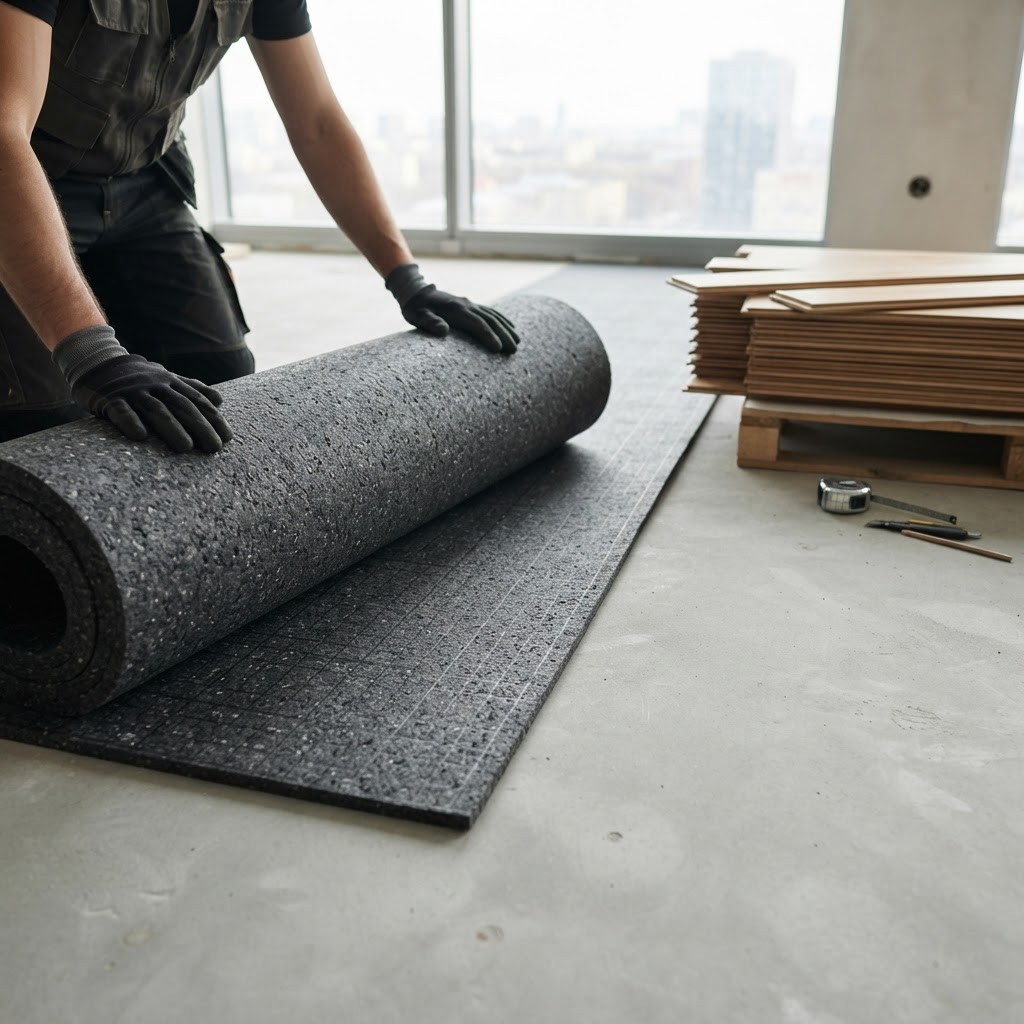
The acoustic underlay is the layer between the structural slab (or screed) and the finished floor. Its job is to decouple the hard finish from the slab so impact energy is absorbed rather than transmitted. Product families:
- Rubber crumb and rubber-in-shear underlays: dense, resilient, high load capacity, suited to hotel traffic; typical thicknesses 3 to 8 mm; strong performance on both impact sound and footfall comfort
- Cork underlays: natural, dimensionally stable, good under wood and vinyl; also used as a resilient layer in machine pads
- Fibre and felt underlays: recycled or mineral fibre, effective for heavy impact such as gym floors, often combined with floating screeds
- Polyurethane foam underlays: economical, lightweight, suited to lower-load areas; densification under point loads must be checked
- Combination and acoustic vinyl underlays: multi-layer products pairing foam or fibre with a resilient film, delivering high impact rating gains in thin builds
Specification points that decide performance:
- Declared performance, not marketing words: ask for the laboratory report (ISO 10140 / ASTM E492 based) showing the floor system's Ln,w or IIC, tested on a representative concrete slab, not the underlay alone
- Compatibility with the finish: click flooring, glued vinyl and loose-lay systems each need the underlay the manufacturer approves, otherwise warranties are void
- Load behaviour: under beds, wardrobes and heavy fittings, a cheap foam underlay flattens permanently; hotel-grade rubber and cork recover
- Joints and seams: taped, sealed joints, and perimeter isolation strips so impact energy cannot flank around the underlay at walls
- Moisture and heat: underlays in the Gulf must tolerate slab moisture in coastal towers and, where installed, underfloor cooling or heating systems
A correctly chosen underlay typically improves the impact rating of a hard hotel floor by 10 to 20 dB (roughly 10 to 20 IIC points), which is the difference between constant footstep complaints and silence.
Resilient Layers and Floating Floors
Where heavy impact or high performance is needed (gyms above guest rooms, spas, ballrooms), the proven solution is a floating floor: a resilient layer laid under a screed or board system so the entire floor mass floats on the structure:
- Resilient screed layers: rubber crumb mats, mineral wool or cork boards, 5 to 25 mm, under a 40 to 75 mm screed, with jack-up or pedestal systems where load demands it
- Isolation of the floating element from walls: perimeter edge strips prevent rigid contact that would short-circuit the isolation
- Performance: floating floor systems routinely achieve Ln,w values well below 45 dB, comfortably inside premium hotel criteria for gyms and pool halls
Vibration Pads Under Plinths and Equipment
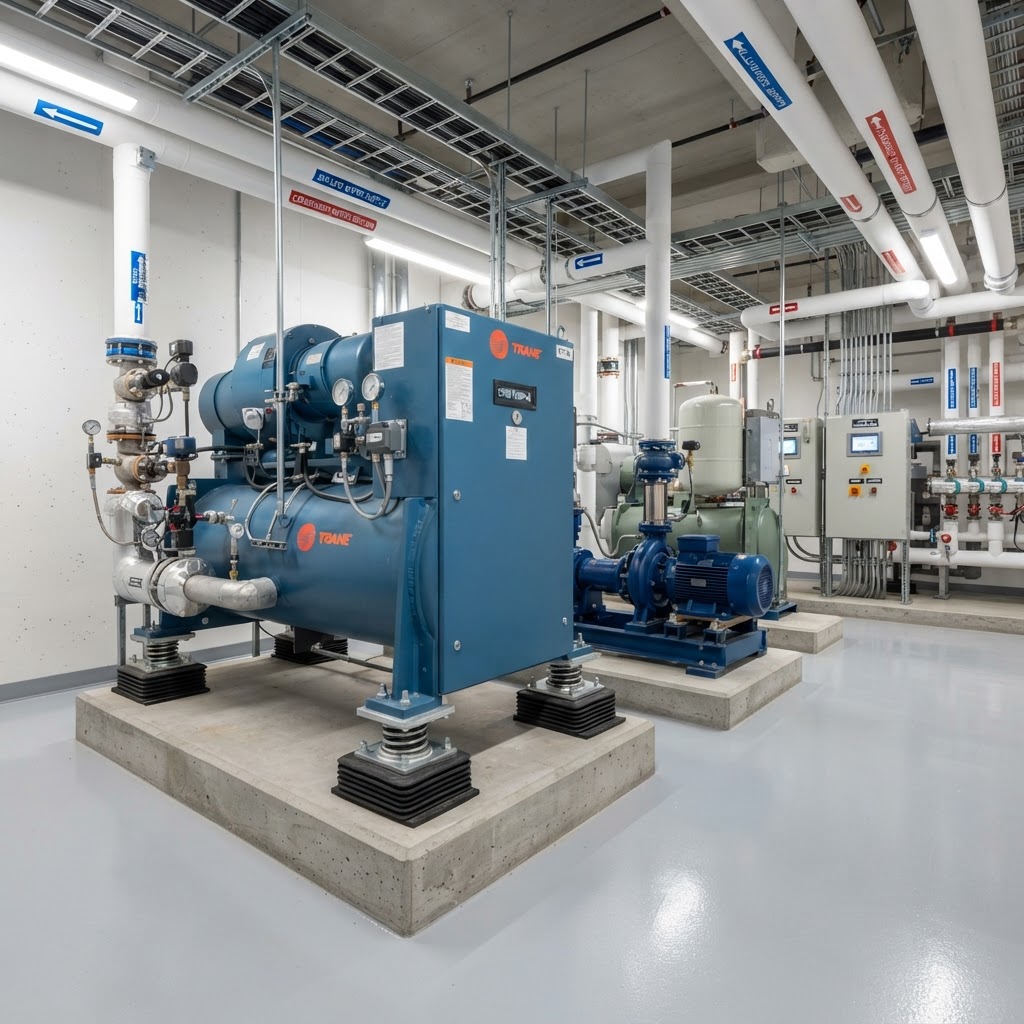
The plant room is where a hotel's acoustic reputation is actually decided. Equipment is normally set on concrete plinths, and the interface between plinth and equipment is where vibration isolation happens. The product families:
- Rubber and neoprene pads: ribbed or waffle-pattern pads, cork-rubber composites and rubber-in-shear blocks placed under equipment feet or between plinth and structure. Suited to mid and high frequency sources: air handling units, fan coil units, exhaust fans, small pumps
- Spring isolators: open or housed springs with static deflections from 25 mm upwards, for low-frequency critical sources: large chillers, cooling towers, pumps and generators. Design isolation efficiencies of 85 to 98 percent are normal when the isolator natural frequency is well below the equipment operating frequency
- Inertia bases: a concrete mass block supporting the machine, itself resting on springs or high-deflection pads. The added mass lowers the system's natural frequency and stabilizes light equipment
- Acoustic hangers and resilient pipe supports: suspended equipment and connected pipework must be isolated too, otherwise the piping re-introduces the vibration that the pads remove
- Flexible connectors: at every isolated machine, flexible duct and pipe connections prevent vibration bridging the isolators into rigid services
Selection rules that professionals apply:
- Match the isolator to the disturbing frequency: the isolator's natural frequency should be at least one third of the machine's operating frequency; aiming for a frequency ratio above 2 (practically 3 to 4) yields high isolation efficiency
- Design for the static load per isolator, never guess: pad overload destroys resilience, spring underload causes instability and rocking
- Isolate the plinth itself where equipment sits in a basement below guest floors: resilient bearing pads between the plinth block and the structural slab cut the transmission path completely
- Keep services flexible and hangers resilient: one rigid pipe clip can bypass an entire spring isolation scheme
- Commission and verify: measure vibration and re-radiated noise levels at handover against the project's acoustic criteria
Walls, Ceilings and Doors Complete the System
Underlays and pads solve impact and structure-borne noise; airborne privacy needs the rest of the envelope:
- Party walls: masonry or double-stud drywall systems with staggered or isolated studs and absorptive cavity insulation, specified to the Rw/STC target, with all joints and penetrations sealed
- Ceilings: acoustic hangers (resilient clips and channels) decouple suspended ceilings from the slab above noisy spaces such as corridors, bars or gyms
- Doors: entrance doors to guest rooms are a classic weak point; perimeter and drop seals, acoustic door construction and fully sealed thresholds are needed to keep corridor noise out
- Flanking control: an underlay, pad or wall system only performs if junctions are sealed; acoustic detailing at skirtings, sockets and service penetrations is where projects quietly fail
Procurement Checklist for Qatar Hotel Projects
- Written acoustic criteria at design stage: define Rw/STC and Ln,w/IIC targets per room pair, and vibration isolation efficiency per equipment item, before ordering any product
- Certified laboratory reports: every underlay, pad and hanger should carry documented performance from recognized testing (ISO 10140, ASTM E90/E492 families or equivalent)
- System performance, not single-product claims: ask suppliers for tested floor and plinth assemblies, not just material datasheets
- Compatibility statements: finish manufacturer approval for the chosen underlay, load tables for pads and springs
- Site delivery protection: pads and underlays must arrive clean, dry and undamaged; a compressed or oil-soaked pad is a failed pad
- Installation supervision: resilient layers and isolation schemes fail at junctions and hangers, so include inspection hold points in the works programme
- Handover verification: impact and airborne field tests (ISO 16283 series) and vibration measurements confirm compliance before the operator's snagging
Frequently Asked Questions
Why is acoustic insulation so important in hotels?
Noise is the leading cause of guest complaints and it directly affects star rating outcomes, brand audits and review scores. Unlike most fit-out defects, poor acoustics usually cannot be corrected after handover without removing finishes, so it must be designed in from the start.
What does an acoustic underlay actually do?
It is a resilient layer between the structural slab and the floor finish that absorbs impact energy (footsteps, dropped objects) instead of letting it pass into the slab and re-radiate in the room below. A hotel-grade underlay typically improves a hard floor's impact rating by 10 to 20 dB.
What are vibration pads under plinths for?
Machines on plant room plinths inject vibration into the structure, which travels through the concrete frame and re-radiates as low-frequency noise in guest rooms far away. Rubber or neoprene pads, spring isolators and inertia bases under the equipment and the plinth break that transmission path, achieving 85 to 98 percent isolation when correctly selected.
What ratings should a hotel floor achieve between guest rooms?
Most international brand standards require roughly STC 50 to 55 (Rw 52 to 57) for airborne sound and IIC 50 to 55 (low Ln,w) for impact sound between vertically stacked guest rooms, with stricter values for gyms, spas and mechanical areas above or beside rooms.
Can acoustic problems be fixed after a hotel opens?
Impact and structure-borne problems usually cannot: fixing them means lifting finishes or opening plant rooms, which is why underlays, pads and isolation are contract items, not post-occupancy repairs. Airborne weaknesses in doors and ceilings are more treatable with seals and upgrades.
Are vibration isolation and acoustic insulation the same product category?
No. Acoustic insulation products (underlays, resilient layers, hangers, seals) address airborne and impact sound. Vibration isolators (rubber pads, spring mounts, inertia bases) address structure-borne vibration from machines. Hotels need both, and they fail together when one is missing.
Conclusion
Hotel silence is engineered, not accidental: acoustic underlays under every hard floor, resilient layers under screeds at gyms and spas, and vibration pads, springs and inertia bases under every plinth in the plant room. Specify by written Rw, STC, Ln,w and IIC targets with certified reports, and verify with field tests at handover.
Post a detailed inquiry on Kinetic to receive quotes from verified acoustic underlay and vibration isolation suppliers in Qatar, or get a contact directly from SRG.
Source acoustic and vibration isolation products on Kinetic.
Looking for materials?
Post an inquiry on the Kinetic marketplace and connect with verified suppliers across the Gulf.