
Bridge Bearings in Qatar: QCS 2014 and Ashghal Specifications for Elastomeric, Pot, Disc and Spherical Bearings
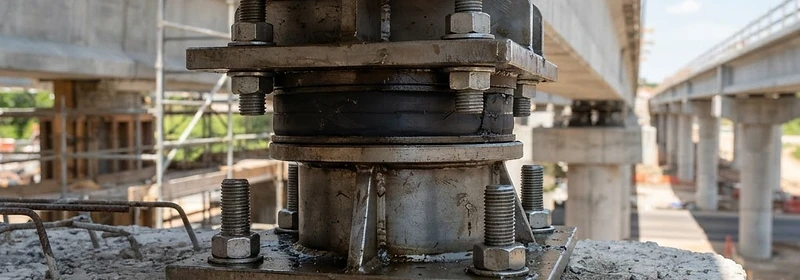
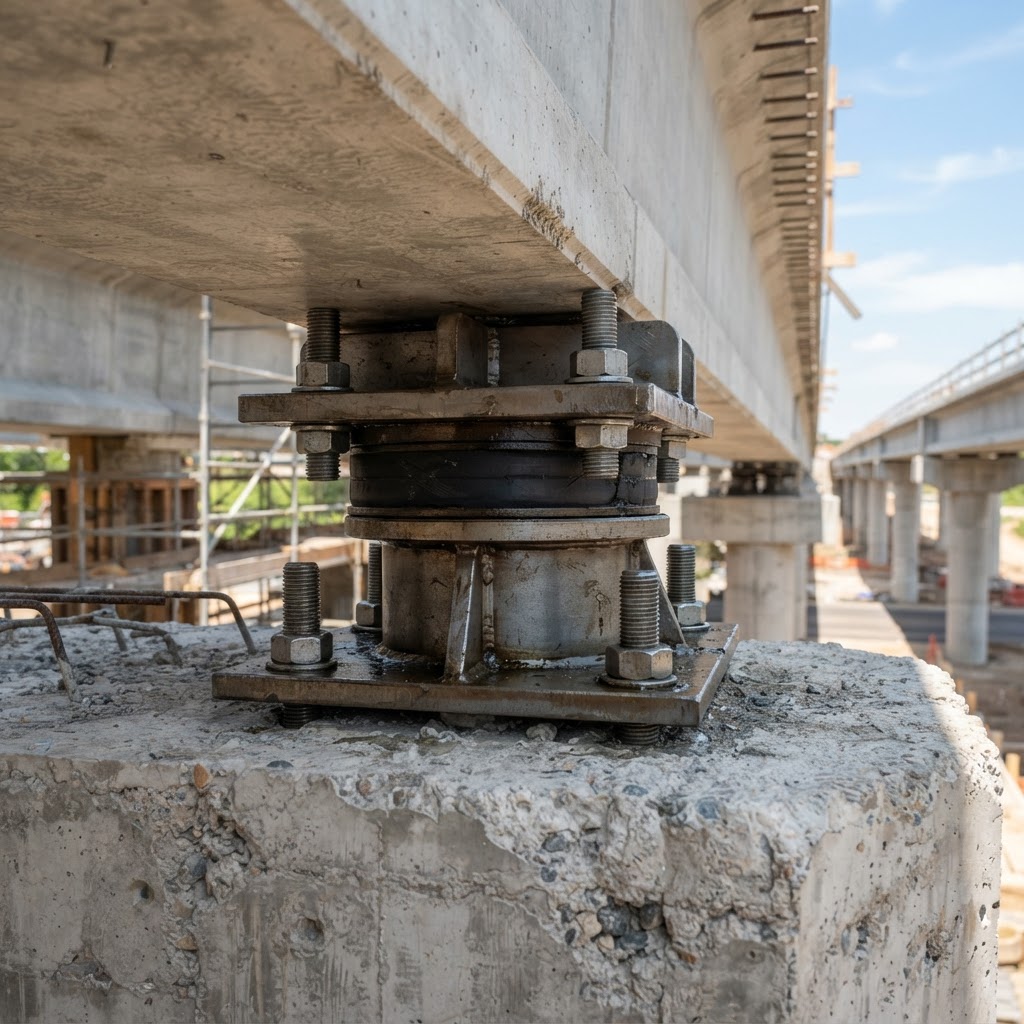
Every bridge is two structures: the deck and the substructure, and the bridge bearing is the engineered connection between them. Bearings carry vertical loads, allow the deck to expand and contract with temperature, accommodate rotation from traffic and creep, and restrain or guide horizontal movements. Get them wrong and the bridge locks up, cracks or walks off its plinth.
In Qatar, bridge bearings are not specified generically. Public Works Authority (Ashghal) projects follow the Qatar Construction Specifications 2014 (QCS 2014), supplemented by Ashghal Interim Advice Notes, and the controlling document for bearings is PWA IAN 006/14 Rev A2, Specification for Bridge Bearings, which adds a new Section 101, Part 3, Bridge Bearings to QCS 2014. This guide extracts the practical requirements from that specification: the bearing types, standards, materials, design rules, corrosion protection, installation tolerances, testing and documentation that suppliers and contractors must meet on Ashghal bridge projects.
How Bridge Bearings Are Specified in Qatar
Two documents govern the work on Ashghal highway structures:
- PWA IAN 006/14 Rev A2, Specification for Bridge Bearings: applies to all bridges with bridge bearings, on all Ashghal projects in design, tender and construction stage. It adds Section 101, Part 3 to QCS 2014 and takes immediate effect
- PWA IAN 009/14 Rev A2, Design Criteria for Highway Structures: sets the design context: bearings shall comply with IAN 006, elastomeric bearings shall be positively located on plinths to prevent walking, tension/up-lift bearings are not permitted unless agreed in writing with Ashghal, and bearings shall be designed for a maximum in-service temperature of 50°C
The design movement comes straight from Ashghal's temperature criteria: a 75°C temperature range (43°C rise, 32°C fall) and a concrete and steel expansion coefficient of 12 x 10-6 per °C. Frictional bearing restraint is assessed per BD 37/01 and BS 5400 Part 9, with pot bearings on greased PTFE assigned a minimum coefficient of friction of 4%. The movement the bearings absorb at the supports must stay coordinated with the joints at the deck ends: see our guide to expansion joint cover systems in Qatar.
Bridge Bearing Types Recognized by the Specification
Section 101, Part 3 recognizes seven bearing types:
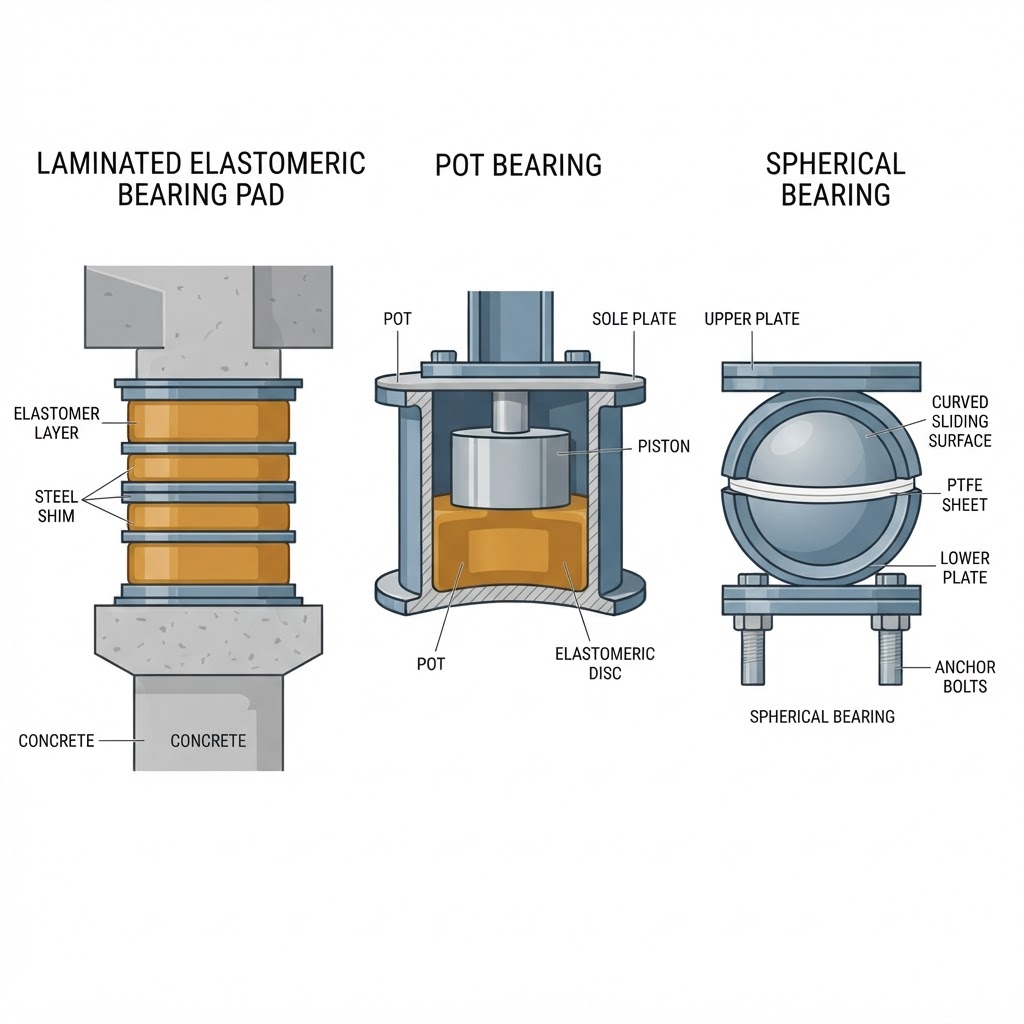
- Moulded reinforced elastomeric bearings: alternate layers of chloroprene or natural rubber vulcanized and bonded to embedded steel or fabric reinforcement. No reclaimed or ground vulcanized rubber is allowed. The reinforcement restrains lateral bulging under load, and the bearing accommodates translation and rotation through deformation of the elastomer
- Disc bearings: a polyether urethane disk confined between steel plates, with a central steel pin transferring lateral loads. A low-profile alternative that accommodates large cyclical live load rotations
- Pot bearings: an elastomeric pad confined inside a steel pot with a piston transferring the load. Confined at constant volume, the elastomer carries very high loads together with structure rotations
- Spherical bearings: a convex stainless steel (or highly corrosion resistant sliding alloy) spherical surface sliding against a concave plate lined with low-friction sliding material. Compact, with large rotation and vertical load capacity
- Moulded elastomeric bearing strips: solid elastomer strips on the abutment backwall corbel supporting the approach slab, with stainless steel dowels preventing longitudinal movement
- Guide and restraint bearings (shear key bearings): transmit horizontal forces without vertical load, per EN 1337-8, with locations shown in PWA SD 5-1-401
Mandatory Standards
Design and manufacture shall comply with the EN 1337 structural bearing series:
- EN 1337-1 general design rules, including the bearing schedule format
- EN 1337-2 sliding elements
- EN 1337-3 elastomeric bearings
- EN 1337-5 pot bearings
- EN 1337-7 spherical and cylindrical bearings
- EN 1337-8 guide and restraint bearings
- EN 1337-9 corrosion protection
- EN 1337-10 inspection and maintenance
- EN 1337-11 transport, storage and installation
- EN 15129 anti-seismic devices, where elastomeric bearings act as low damping isolators
- European Assessment Documents (EADs), which manufacturers use to obtain a European Technical Assessment (ETA)
Advisory standards include BS 5400-9.1 and 9.2:1983, the AASHTO LRFD bridge design and construction specifications, and the UK Design Manual for Roads and Bridges (DMRB).
Material Requirements from the Specification
The materials clauses read like a procurement checklist:
- Structural steel: grade S355 or S235 to EN 10025. Sliding material substrates are grit blasted before bonding, and machined metal-to-metal contact surfaces are machined only after welding is complete. Only new materials are accepted, and each batch needs approval from an independent testing authority (BBA or MPA Stuttgart or similar)
- Stainless steel sheet: EN 10088-4 grades 1.4401 or 1.4404 for sliding counterparts
- Sliding materials: PTFE sheets 5 mm to 8 mm thick, or approved special sliding material (SSM), a modified UHMWPE, proven by long-term test at 60 N/mm² contact pressure, 15 mm/s sliding velocity and 50 km sliding path. Low friction behaviour means µ below 2.0% across -50°C to +70°C, and not exceeding 3.5% in a -35°C long-term test. Because of Qatar's heat, the characteristic permissible pressure of the sliding material must be at least 180 N/mm² at 20°C and 90 N/mm² at 70°C, confirmed by independent testing
- Adhesive: epoxy to ASTM C881/C881M, stable from -40°C to +125°C, applied uniformly over the full area
- Pot bearing elastomer: neoprene (polychloroprene) or virgin natural rubber moulded in one piece, no stacked discs, with integrally moulded sealing grooves, silicone grease lubrication, physical properties per EN 1337-5
- Brass sealing rings: three rectangular rings per pot, finished to 1.6 µm RMS or better, each cut at 45° with a 1 mm gap, gaps staggered a minimum of 90°. Ring width is at least 2% of the pot internal diameter or 6 mm, and never more than 20 mm
- Disc bearing rotation element: single-piece moulded polyether urethane, 100% polyether urethane with no reclaim, hardness 60 to 65 Shore D, ultimate elongation at least 220%, compression set no more than 40% after 22 hours at 70°C, and steel temperature adjacent to the disk never exceeding 107°C
- Elastomeric bearing reinforcement: internal steel plates deburred before moulding, minimum 3 mm thick, minimum 6 mm elastomer cover, no tapered layers, cover layers no thicker than 70% of internal layers, and holes strongly discouraged
- External seals: tight-fitting, durable for more than 50 years, preventing dust ingress to moving parts
Design Requirements
The design clauses set hard limits that submittal calculations must demonstrate:
- At serviceability, the horizontal load on a bearing shall not exceed 40% of the corresponding vertical load, and the minimum vertical load shall not be less than 20% of the maximum vertical design load, unless agreed with Ashghal
- Bearings are designed for a maximum in-service temperature of 50°C, compatible with the bridge design life
- Rotational capacity about any horizontal axis shall be at least ±0.02 radians, including installation tolerances and uncertainty. For pot and disc bearings, the strain at the rotation element perimeter shall not exceed 15% of its thickness under combined loads including creep
- Vertical and horizontal clearance between rotating and non-rotating parts shall be at least 5 mm when rotated to 150% of the design rotation
- Guides for unidirectional bearings are fabricated integral with the base element: bolted or welded central guides are not permitted
- Top and bottom adapter plates are mandatory to allow simple replacement without cutting into the structure, minimum 20 mm thick, machined after welding, with an evenness of at least 0.0003 times the diagonal of the attached bearing element
- Bearings shall be replaceable by lifting the deck no more than 10 mm, and the design shall permit removal with minimal jacking, including for assessment of jack failure scenarios
- Dust covers on the bearing circumference are UV resistant, replaceable and warrantied for at least 15 years
Corrosion Protection for the Gulf Environment
The specification is written for a marine desert environment. All exposed non-stainless steel parts receive a high marine coating system, corrosivity category C5-M to ISO 12944-5, with high durability (more than 15 years):
- Abrasive blasting to Sa 2 1/2 (Swedish Standard SIS 05 59 00)
- Zinc dust epoxy primer or zinc flame spray, minimum 80 µm
- Two coats of micaceous iron oxide (MIO), minimum 80 µm each, then a final MIO coat, minimum 80 µm
- Total coating thickness not less than 320 µm, including a 50 mm transition zone on adapter plates in contact with concrete
- Anchor bolts hot-dip galvanized to EN ISO 10684, with lubricated threads and UV-resistant plastic caps over bolt heads warrantied for five years
- No coating on pot internals or piston surfaces in contact with the elastomer
Installation Requirements and Tolerances
Section 101, Part 3 is unusually specific about installation:
- Bearings are installed using precision two-axis spirit levels on a measuring plane with three pins, checked in longitudinal, lateral and diagonal directions
- Centre lines within ±3 mm of the correct position
- Level within ±0.0001 times the sum of adjacent spans, and never more than ±5 mm
- Inclination to the horizontal within ±0.1° in any direction
- Bearings are adjusted for temperature at installation time, falsework release and prestressing shortening. Adjustments requiring dismantling are done in the factory, never on site, except under manufacturer supervision
- The manufacturer's technical representative must be present for the first elastomeric, unidirectional, multidirectional and fixed bearing placed
- Rehabilitation, modification and repair are carried out only in the factory or an approved engineering works
- Elastomeric bearings are positively located on their plinths with galvanized guide bars welded to the masonry plate on all four sides, in addition to epoxy or vulcanized bonding
- Bearings sit on plinths out of reach of any flooding of abutment galleries and pier tops, and abutment bearings are accessible through inspection galleries
Every bearing is stamped with the manufacturer, type, number, installation direction and location, plus a bold displacement direction arrow, so the as-built can be read off the installed bearing.
Testing, Monitoring and Documentation
The acceptance regime is evidence-based:
- An ETA must be submitted guaranteeing working life, not less than 50 years for spherical bearings, issued by BBA or MPA Stuttgart
- Friction properties are established by actual tests at 70°C on the relevant sliding materials
- The Engineer may select an entire bearing from the contract batch for testing, at the contractor's cost including the replacement bearing
- The contractor funds a factory visit for the Engineer and a client representative to inspect and dismantle a typical unidirectional, multidirectional and fixed bearing, and to witness a nominated bearing test
- Each bridge or module carries at least two bearings fitted with load cells, accurate to 5%, recording loads through construction to handover to PWA Assets Affairs, with spherical bearings also carrying sliding material and cumulative displacement sensors
- Sliding plates are fitted with graduated scales for inspection monitoring
- The documentation package includes design and working drawings, compliance certificates, the ETA, third-party certificates, welding certificates, load test records, as-installed details including bench line measurements, and inspection, maintenance and replacement procedures with risk assessments
- A written guarantee covers 15 years from substantial completion, including replacement supply and installation at no cost if bearings fail to perform within the design movement and loads
Sourcing Bridge Bearings in Qatar: What Suppliers Must Prove
For trading companies and bearing suppliers approaching Qatar projects, the submittal list is the specification in miniature: manufacturer specification, ETA, shop drawings with a bearing schedule to EN 1337-1, design calculations stamped by a professional engineer with at least five years of documented bearing design experience, friction tests at 70°C, installation and replacement method statements, a compliance certificate, and evidence of comparable proprietary bearings successfully operating in the Middle East's heavy traffic, aggressive environment and high temperatures. Lead time matters as much as price: bearings are engineered to order, the factory inspection is mandatory before shipping, and a certificate of origin must accompany the shipment.
Frequently Asked Questions
What specification governs bridge bearings in Qatar?
QCS 2014 as supplemented by Ashghal Interim Advice Note 006/14 Rev A2, Specification for Bridge Bearings, which adds Section 101, Part 3 to QCS 2014. It applies to all Ashghal projects in design, tender and construction stage.
Which bearing types are allowed by Ashghal?
Moulded reinforced elastomeric bearings, disc bearings, pot bearings, spherical bearings, moulded elastomeric strips for approach slabs, and guide or restraint (shear key) bearings per EN 1337-8.
What standards must bridge bearings comply with in Qatar?
The EN 1337 series (parts 1, 2, 3, 5, 7, 8, 9, 10 and 11), EN 15129 for anti-seismic applications, and a European Technical Assessment obtained through the EAD system. AASHTO LRFD and BS 5400-9 are advisory references.
What temperature do bridge bearings in Qatar need to be designed for?
A maximum in-service temperature of 50°C, within Ashghal's 75°C bridge temperature range. Sliding materials must be tested for performance at 30°C to 70°C, with permissible pressure of at least 90 N/mm² at 70°C.
What are the installation tolerances for bridge bearings?
Centre lines within ±3 mm, level within ±0.0001 times the sum of adjacent spans and never more than ±5 mm, inclination within ±0.1°, set with precision spirit levels and adjusted for the temperature at installation.
How long do bridge bearings last on Ashghal projects?
The ETA must guarantee the working life, at least 50 years for spherical bearings. External seals must last more than 50 years, and the contractor provides a 15-year performance guarantee including replacement at no cost.
What corrosion protection is required?
A C5-M high marine coating system to ISO 12944-5: blasting to Sa 2 1/2, zinc-based primer, three MIO coats, total thickness at least 320 µm, plus hot-dip galvanized anchor bolts to EN ISO 10684.
Can elastomeric bearings be installed loose on the plinth?
No. Ashghal requires elastomeric bearings to be positively located on their plinths by guide bars welded to the galvanized masonry plate on all four sides, in addition to epoxy or vulcanized bonding, to prevent walking during expansion and contraction.
Conclusion
Qatar's bridge bearing specification is one of the most demanding in the region, and it is built for the environment: 50°C service temperature, C5-M marine coatings, PTFE and SSM sliding surfaces tested at Gulf temperatures, EN 1337 conformity, load cells and graduated scales for lifecycle monitoring, and a 15-year performance guarantee. For contractors and suppliers, the path to approval is complete documentation: the ETA, the stamped calculations, the 70°C friction tests, and the factory inspection, long before the first bearing reaches site.
Post a detailed inquiry on Kinetic to receive quotes from verified suppliers of bridge bearings and expansion joint systems in Qatar, or get a contact directly from SRG.
Source bridge bearings and structural bearing systems on Kinetic.
Related Articles


Looking for materials?
Post an inquiry on the Kinetic marketplace and connect with verified suppliers across the Gulf.