
Steel Rebar Suppliers in the Gulf: Grades, Standards and Procurement Guide
Reinforcement bar is the single largest tonnage item on almost every concrete package in Qatar and the wider Gulf, and the item most often bought on price alone. That is how projects end up with inspection failures, rejected mill certificates and bars that do not match the design drawings.
This guide covers what to specify, how to verify it, where the corrosion risk actually sits, how pricing works, and how to structure supply so the pour programme never waits on steel.
Grades and standards you will meet
BS 4449, common grades B500A, B500B and B500C, yield strength 500 MPa, typical origin Turkey, UAE and Oman.
ASTM A615, grades 40, 60 and 75, with 420 MPa yield for Grade 60, typical origin Turkey, India and China.
EN 10080, B500B with CE marking, 500 MPa, origin Europe and Turkey.
SASO 2527, B500B, 500 MPa, from Saudi domestic mills.
The letter after the grade matters. B500A has lower ductility and is not ductility class B or C, B500B is the default for Gulf structures, and B500C gives higher elongation for seismic or heavily stressed sections. If the specification calls for ductility class B and the supplier delivers A, the material can be rejected on paper even though the yield strength matches.
Do not mix standards on one project. BS and ASTM bars look identical on site and have different yield strengths and mass tolerances, so a delivery that mixes them will fail inspection.
Diameters, scheduling and couplers
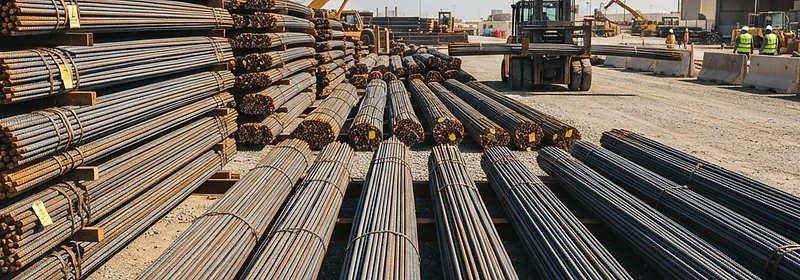
Common diameters run 8, 10, 12, 16, 20, 25, 32 and 40 mm, with 6 mm for links and spacers in some markets. Bars arrive straight in 12 m lengths or in coils that are decoiled and cut to the bar bending schedule on site or at a cutting yard.
The bar bending schedule should follow a recognised convention such as BS 8666. A schedule with ambiguous shape codes is the most common cause of a rejected bar delivery, and the error is usually found after the bars are bent, when the material is already scrap.
Mechanical couplers replace lap lengths at congested columns, transfer beams and precast joints. They reduce steel tonnage, remove the lap congestion that stops concrete reaching the bar, and give a more predictable tension path than a lap splice in a large bar. Specify the coupler system with its test evidence, and make sure the threading is done at a controlled yard rather than improvised on site.
Corrosion and the Gulf environment
Black steel is the default. In splash zones, marine structures and coastal foundations, the choices are hot dip galvanising to ISO 1461, epoxy coating, or stainless for the most exposed elements.
Corrosion risk on a Gulf site is driven less by the air than by the concrete. Adequate cover, a low water to cement ratio and a sulphate resisting mix do more than any coating. Where cover cannot be achieved, coatings and corrosion inhibitors earn their cost.
Mill scale is normal and light surface rust on stored bar is usually acceptable. Deep pitting, section loss or chloride contamination from sea water exposure is not, and those bars should be rejected rather than cleaned and used.
What to verify on delivery
- Mill test certificate matching the heat numbers on the bar tags, not a generic certificate for the grade
- Yield strength, tensile strength, elongation and bend test results for the actual heat
- Mass per metre against the tolerance in the standard, typically plus or minus 4.5 percent for BS 4449
- Bar marking and tag legibility, since unstamped bar is unverifiable bar
- Third party testing for the first delivery and then at a defined frequency, at an approved Qatar laboratory
- Origin documentation where the project specification restricts country of manufacture
The most expensive failure is not a rejected load, it is a structure poured with bars from a heat that was never tested. Insist that certificate, tag and heat number agree before the steel goes near the shutter.
How pricing actually works
Gulf rebar prices track international billet and Turkish scrap, with roughly a four to six week lag before they reach a Doha quote. The main drivers are:
- Scrap and billet costs in Turkey, the largest regional exporter
- Energy cost at the rolling mill
- Freight and insurance to Hamad Port or Jebel Ali
- Local demand from mega projects, which moves regional availability sharply
- Currency, since most rebar is traded in USD against a pegged QAR
For large packages, a price formula tied to a published index protects both sides better than a fixed price with a risk premium built in. For smaller packages, a fixed price with a defined delivery window is simpler.
Supply structure that protects the programme
- Split the package between two origins so one mill outage does not stop the site
- Hold a rolling stock buffer for the next two weeks of fixing, not the whole package
- Book cut and bend capacity early, since bending is often the real bottleneck, not the mill
- Agree delivery sequence against the pour schedule, not against the order date
- Confirm the fabricator can handle large diameter bars if the design uses 32 mm and above
Sourcing through Kinetic
Post an inquiry with grade and standard, diameter mix, total tonnage, cut and bend requirement, delivery sequence and project location. Verified mills, traders and fabricators respond with quotes, and contact details stay locked until you accept a bid.
For the materials that sit around the steel, see our guides to cement and ready-mix concrete in Qatar and gabbro aggregates.
Frequently asked questions
Is B500B the same as Grade 60? No. B500B is 500 MPa yield under BS 4449, Grade 60 is 420 MPa under ASTM A615. They are not interchangeable in design.
Can surface rusted bar be used? Light surface rust with no section loss is normally acceptable. Pitting, flaking or chloride contamination is not.
Do couplers replace laps everywhere? No. They are used where laps are impractical, at congested joints and where the design calls for mechanical splices with test evidence.
How long does mill supply take? Rolled stock from regional mills is typically two to four weeks to Doha, cut and bend adds a week to ten days, and imported tonnage from further afield runs six to ten weeks.
What documentation should be submitted? Mill certificates with heat numbers, third party test reports, mill origin declaration and the approved bar bending schedule.
Source rebar, cement and structural materials from verified suppliers on Kinetic.
Related Articles

Bridge Bearings in Qatar: QCS 2014 & Ashghal Specifications for Elastomeric, Pot, Disc & Spherical Bearings
17 Oct 2026

Operable Walls in Qatar: Vertically Retractable Acoustic Partitions for Hotels, Ballrooms and Conference Venues
1 Nov 2026

EMC and RF Testing for Qatar Projects: Chamber Validation, Shielding and Compliance
1 Nov 2026Looking for materials?
Post an inquiry on the Kinetic marketplace and connect with verified suppliers across the Gulf.