

Dialysis Box Systems in Qatar: Backflow Prevention, Trap Primers & Infection Control for Hemodialysis Units
Every hemodialysis chair has a hidden plumbing risk behind it: a water supply connection and a drain that sit a few centimetres from a patient connected to a machine. If water ever flows backward, or if a dry drain trap lets sewer gas into the room, the consequence is not a plumbing defect but a patient-safety event. That is why modern dialysis facilities specify a dialysis box: a recessed, prefabricated stainless steel enclosure that combines the supply connection, backflow preventer, trap primer and waste connection for each treatment station in a single, repeatable unit.
This guide explains what a dialysis box is, how it works, why per-station backflow protection matters, what the engineering and cost case looks like, and how to specify and source dialysis boxes for hospitals, ambulatory dialysis units and private clinics in Qatar and the GCC.
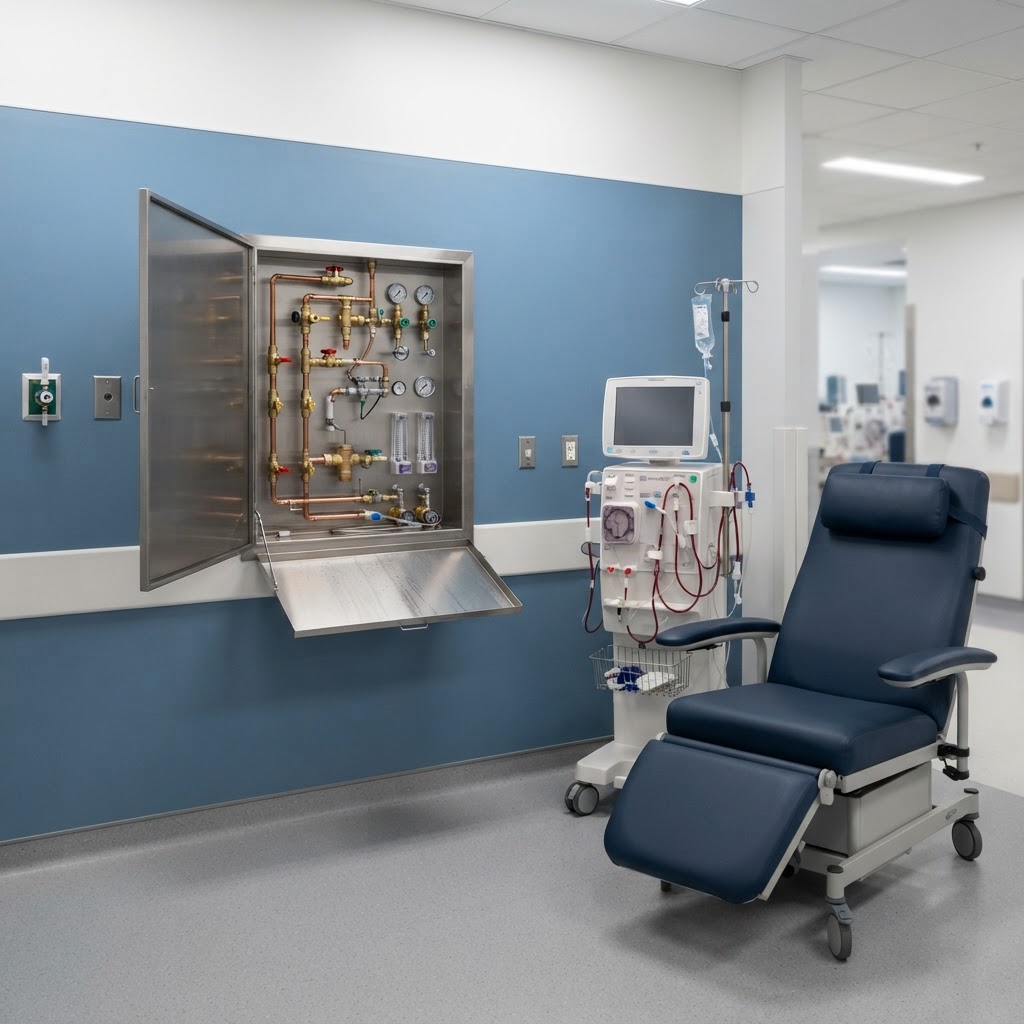
What Is a Dialysis Box?
A dialysis box (also called a dialysis wall box, dialysis outlet box or dialysis supply and waste box) is a recessed wall enclosure installed at each hemodialysis station. It gives the dialysis machine a controlled point to connect to treated water supply and to discharge waste, without exposed pipework, loose hoses on the floor or shared plumbing between patients.
A fully equipped, prefabricated dialysis box typically integrates:
- Reduced pressure backflow preventer: a mechanical device that stops water flowing back from the station into the building supply, even during a pressure drop or back-siphon event
- Trap primer: a device that releases small amounts of water into the drain when it senses pressure fluctuation, keeping the P-trap wet so the seal holds and sewer gas cannot enter the room
- Supply shut-off valve: normally open, closed only to service the trap primer or backflow device
- Dialysis water supply connection: a potable water outlet, usually a male hose thread adapter, for the dialysis machine
- Waste connection: typically a 2 inch IPS drain
- Fold-down drip tray: catches spillage from supply or discharge hoses so it does not run down the cabinet and wall
- Discharge hose bracket, mounting tabs and concealed hinge: for clean installation and easy access
- Optional thermostatic mixing valve and temperature gauge: to temper hot and cold water to the temperature the dialysis machine needs (many machines operate at roughly 75 to 78 degrees Fahrenheit, about 24 to 26 degrees Celsius)
The enclosure itself is normally stainless steel, recessed flush into the wall, with a door that closes the whole assembly away when the station is not in use.
Why Per-Station Backflow Prevention Matters
In a hemodialysis unit, many patients are treated at the same time from the same water system. Water quality for dialysis is governed by the ISO 23500 family of standards (including ISO 23500-3 on water for dialysis fluids), and facility guidance commonly recommends backflow prevention at the point where the dialysis water system connects to the potable supply.
The weak point in many older designs is that a single backflow preventer protects the building, not the patients:
- Some local plumbing codes only require one backflow prevention device for multiple water outlets, which protects the building supply but does not isolate one patient station from the next
- If one station experiences a contamination event, other stations on the same line can be exposed
- Long runs of piping between the shared backflow device and the stations create dead-legs where water can stagnate, raising the risk of bacterial growth
A dialysis box with an integrated reduced pressure backflow preventer moves protection to the point of use. Each patient station is isolated on its own, patients are not linked to one another through the water supply, and the facility's main supply is protected at the same time. For hospital owners and consultants, this is also a liability argument: the safest design is the one that removes the shared failure path.
Traditional Piping vs. Modular Dialysis Boxes
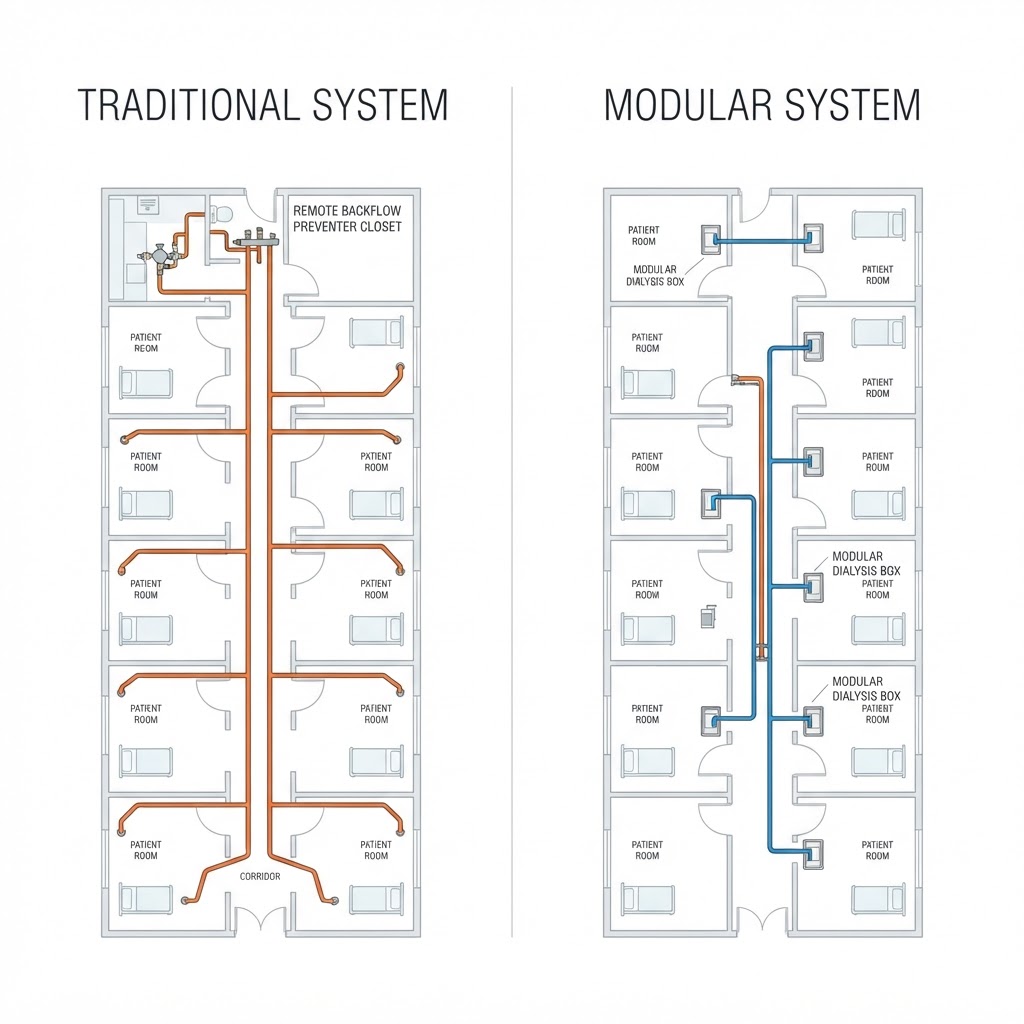
The main design choice is between a traditional system (a remote backflow preventer closet, with long supply lines to many rooms) and a modular system (a prefabricated dialysis box in every patient room).
A manufacturer case study of a 22-patient-bed floor, published by the maker of one well-known dialysis box range, compared the two approaches. These are manufacturer-reported figures for one US project and should be treated as an illustration, not a guarantee for any specific Qatar project:
| Item | Traditional system | Modular dialysis box system |
|---|---|---|
| Estimated labor | More than 840 hours | About 303 hours |
| Estimated cost | More than $128,000 | About $89,000 |
| Reported saving | Baseline | About 64 percent less labor, more than 30 percent lower cost |
The reasons behind the difference are mostly mechanical:
- The box arrives pre-plumbed, so site work is reduced to a few connections per room
- It eliminates the need for a designated room to house a central backflow preventer
- It cuts excess piping, hangers and the BIM coordination effort for crowded ceiling voids
- Fewer joints and connections mean fewer opportunities for installation error
- The result is repeatable: once the first room is installed correctly, every other room follows the same detail
Common Dialysis Box Models and Options
Dialysis boxes are sold in a small number of standard configurations, which can then be customised:
- Dialysis box with backflow preventer and trap primer: the core configuration, with supply shut-off, reduced pressure backflow preventer, trap primer, fold-down drip tray and waste connection
- Dialysis box with backflow preventer, trap primer and thermostatic mixing valve: adds a mixing valve, temperature gauge and isolation valves so water arrives at the dialysis machine at the correct temperature, adjustable for seasonal changes
- Basic supply and waste box: a recessed box with a connection and drain only, with the backflow device located elsewhere (the traditional approach)
Typical customisation options include:
- Back inlet for water entry instead of a top inlet
- Quick-disconnect supply fitting for the dialysis machine
- Supply without the door, for installations with a separate access panel
- Custom sizing and specifications to match cabinetry and wall depth
Why This Matters for Qatar and the GCC
Dialysis capacity is a growing healthcare priority in Qatar. Hamad Medical Corporation is the principal public provider, and HMC has publicly stated that kidney impairment is common in the population. In May 2024, HMC and the Primary Health Care Corporation opened a new eight-bed ambulatory dialysis unit at Muaither Health Center, one of four ambulatory dialysis units alongside Al Wakra, Al Shehaniya and Al Shamal, reflecting a policy of bringing dialysis closer to patients.
For consultants, MEP contractors and facility owners, this growth creates repeated demand for the same detail:
- New hospital towers and ambulatory units need dialysis stations designed from the start
- Private clinics and specialist centres entering renal care need a code-compliant, inspection-ready plumbing solution
- Fast-track programmes benefit from prefabricated, pre-plumbed components that shorten site installation time
- Hot climate conditions make temperature control at the point of use more important: incoming cold water in Gulf summers can be warmer than the dialysis machine requires, which is where a thermostatic mixing valve helps
- Healthcare authority review favours designs that are standard, documented and repeatable across many rooms
Specifying a Dialysis Box: A Practical Checklist
For consultants and MEP contractors preparing a specification or technical submittal:
- Define the water source: confirm the dialysis water supply, treatment system and any code requirements for backflow protection at the point of use
- Choose the configuration: backflow preventer and trap primer as a minimum, adding a thermostatic mixing valve where temperature control at the station is required
- Confirm materials: stainless steel enclosure, copper or approved piping, and certified backflow device with documented approvals
- Check dimensions and mounting: recess depth, wall build-up, mounting tabs and door swing against cabinetry drawings
- Define connections: inlet position (top or back), hose connection type and waste connection size
- Plan access for service: the supply shut-off valve and backflow device must be reachable for periodic testing and maintenance
- Request documentation: product data sheets, approvals, installation instructions and test procedures for the submittal
- Coordinate trades: align plumbing, carpentry and electrical rough-in so every room uses the same standard detail
- Plan commissioning: flush and disinfect potable water piping before occupancy, test backflow preventers and record the results
Frequently Asked Questions
What is a dialysis box?
A dialysis box is a recessed, prefabricated stainless steel wall enclosure installed at each hemodialysis station. It contains the water supply connection, a backflow preventer, a trap primer and the waste connection for the dialysis machine in one clean, repeatable unit.
Why do dialysis stations need a backflow preventer at each station?
A single backflow device for many outlets protects the building supply but not the individual patients. A reduced pressure backflow preventer at each station isolates every patient on their own and stops cross-contamination if a back-siphon or pressure event occurs.
What does a trap primer do in a dialysis box?
It periodically releases small amounts of water into the drain so the P-trap stays wet. A wet trap keeps the seal intact and prevents sewer gas and odours from entering the treatment room.
Do dialysis boxes include temperature control?
Some do. Versions with a thermostatic mixing valve and temperature gauge temper the supply to the temperature the dialysis machine needs and allow adjustment for seasonal variation. The basic version does not include a mixing valve.
Is a modular dialysis box cheaper than traditional piping?
In one manufacturer case study of a 22-bed floor, the modular system was estimated at roughly 64 percent fewer labor hours and more than 30 percent lower cost. Actual savings depend on the layout, local labor rates and design, so a project-specific comparison is recommended.
Who needs dialysis boxes in Qatar?
Hospitals, ambulatory dialysis units, private nephrology clinics, and the consultants and MEP contractors who design and install them. Any facility adding hemodialysis stations needs a code-compliant supply and waste solution at each chair.
Can dialysis boxes be customised?
Yes. Typical options include a back inlet, a quick-disconnect supply fitting for the dialysis machine, supply without the door, and custom sizing to fit cabinetry and wall depth.
Conclusion
A dialysis box is a small component that carries a large responsibility: it is the point where building water, a patient and a machine meet. Moving backflow prevention, trap priming and waste handling into a prefabricated, per-station enclosure protects patients, reduces facility liability and, according to manufacturer case data, can shorten installation time and cost compared with traditional piping.
For hospital projects, ambulatory units and private dialysis clinics in Qatar, the practical path is to define the configuration early, request documented approvals, and standardise one detail across every room.
Post a detailed inquiry on Kinetic to receive quotes from verified suppliers of dialysis boxes and healthcare plumbing products in Qatar, or get a contact directly from SRG.
Source dialysis boxes and healthcare plumbing products on Kinetic.
Related Articles

Anti-Vandal & Ligature-Resistant Stainless Steel Sanitary Ware in Qatar: Showers, Faucets and Drains for Behavioral Health, Detention and Public Facilities
22 Oct 2026

Operable Walls in Qatar: Vertically Retractable Acoustic Partitions for Hotels, Ballrooms and Conference Venues
1 Nov 2026

EMC and RF Testing for Qatar Projects: Chamber Validation, Shielding and Compliance
1 Nov 2026Looking for materials?
Post an inquiry on the Kinetic marketplace and connect with verified suppliers across the Gulf.