
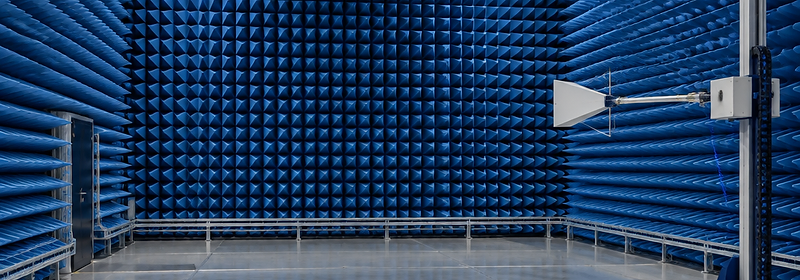
EMC and RF Testing for Qatar Projects: Chamber Validation, Shielding and Compliance
A shielded room is a promise, not a result. The copper, the steel, the gasketed door and the absorber lining only mean something once the room has been measured and the measurement has been documented against a recognised standard. That is what EMC and RF testing does, and it is the step most often missing from Qatar projects that install a chamber or a shielded enclosure.
The consequences are quiet until they are expensive. A data centre accepts equipment that was never proven to meet emissions limits. A hospital installs an MRI room that leaks interference into a neighbouring scanner. A defence facility commissions a room that cannot pass a TEMPEST assessment. The hardware was bought, the room was built, and nobody measured it.
This guide explains what gets tested, what the test names actually mean, what the Gulf climate does to a chamber, and what to demand from a supplier before you sign the commissioning certificate.
Two different questions
EMC testing asks whether a product behaves acceptably in an electromagnetic environment. Shielding and chamber testing asks whether the room behaves as designed. Projects in Qatar usually need both, and they get confused with each other.
Product compliance covers emissions, meaning what the device radiates, and immunity, meaning how it survives interference from outside. Common references are CISPR 11 and CISPR 32 for emissions, IEC 61000-4-3 for radiated immunity, IEC 61000-4-6 for conducted immunity and MIL-STD-461G for defence equipment.
Facility performance covers the room itself: how much signal it blocks, and whether the test volume inside it is quiet enough and uniform enough to make a valid measurement.
What chamber validation actually involves
The names on a validation report look technical because they are, and each one answers a specific question.
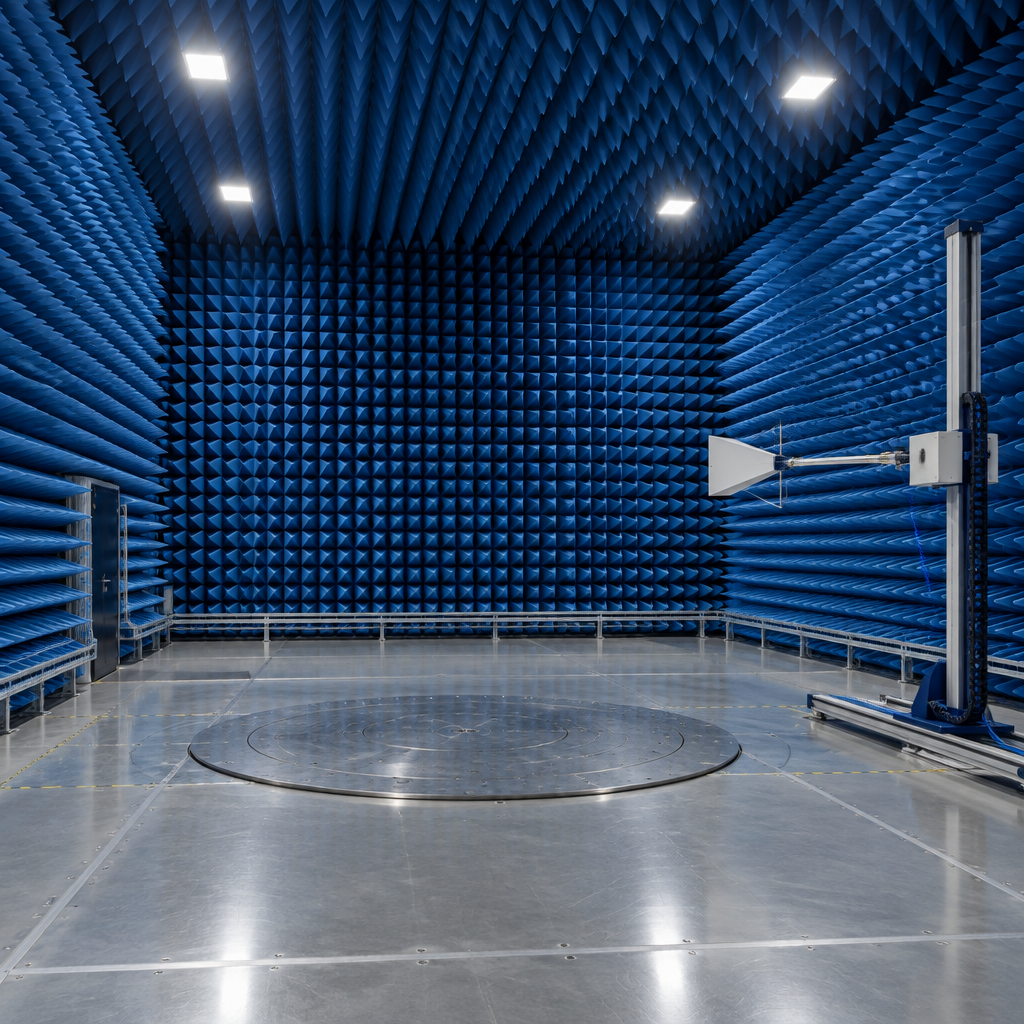
Normalised site attenuation, or NSA, confirms that a radiated emissions test site behaves like an ideal open area test site across the frequency range. It is defined in CISPR 16-1-4 and it is the single most important number on a chamber report.
Site voltage standing wave ratio, or sVSWR, checks the same site above 1 GHz, where reflections and absorber performance matter more than ground plane behaviour.
Field uniformity confirms that a radiated immunity test field is even enough across the test volume, per IEC 61000-4-3. A chamber that fails uniformity produces results that cannot be repeated.
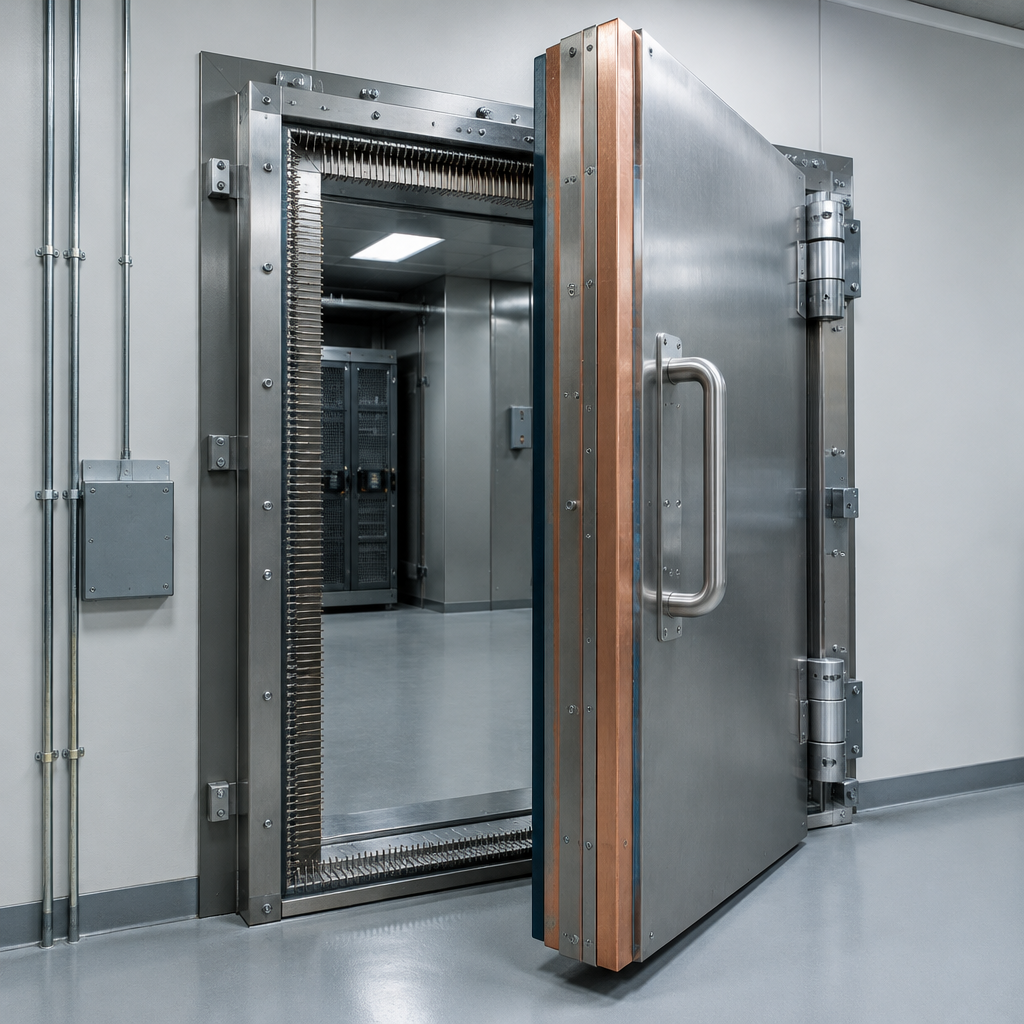
Shielding effectiveness measures attenuation through the enclosure itself, typically assessed to IEEE 299 or EN 50147-1. This is the test that tells you whether the door gaskets, seams and penetrations are actually sealed.
Reverberation chamber assessment applies to mode stirred chambers used for immunity and emissions work, referenced in IEC 61000-4-21.
Why penetrations decide the outcome
Most shielding failures are not in the panels. They are at the interfaces: a cable entering without a filtered penetration, a waveguide beyond cutoff that was cut short, an air conditioning duct with the wrong honeycomb, a door that has settled out of alignment, a grounding strap that was removed during a repair and never replaced.
In Gulf conditions this matters more. Thermal cycling across a facade moves framing. Dust loads the fingers of an RF gasket. Condensation from aggressive air conditioning corrodes contacts. Absorber material degrades faster in heat and dust, and a chamber never re-tested five years after installation is usually not the chamber that was certified.
The Qatar angle
Radio equipment placed on the market in Qatar is regulated by the Communications Regulatory Authority, and equipment approval depends on test evidence from a competent facility, not on a manufacturer statement. Projects in healthcare, data centres, defence and telecom therefore end up needing EMC reports that a consultant and a regulator will both accept.
The practical result is that a chamber or shielded room becomes a procurement item with a service life. It needs a commissioning test, a documented baseline, a maintenance regime and a revalidation interval. Without the baseline, every later argument about interference has no reference point.
If the room is being built for protection rather than measurement, the same discipline applies. Rooms designed against high altitude electromagnetic pulse or intentional electromagnetic interference are only as good as their last penetration audit and their periodic attenuation test, a point covered in our guide to EMP, TEMPEST and hardened rooms in Qatar. Where the shielding is for medical imaging rather than electronics, the construction principles overlap with radiation protection and lead lining installations.
What to demand before commissioning
A validation report naming the standard, not a generic certificate. The report should state test method, frequencies, limits and measured margins.
Calibration certificates for the antennas, receivers and field probes used, current at the date of test.
Witnessed testing at commissioning, with your consultant present or with a signed site test record.
A penetration register, listing every cable, duct and pipe entering the room, with the filter or waveguide protecting it.
A maintenance plan covering door gasket inspection, absorber condition, filter checks and the revalidation interval.
Spare gasket material and door hardware, because a chamber that stops working on a door seal should not wait months for a shipment.
Common failures seen on real projects
- A chamber validated empty, then filled with equipment racks that were never considered in the field uniformity assessment.
- Cable trays bonded at one end only, or bonded with a strap that corroded.
- Filters sized for normal load, then bypassed when a contractor needed a quick connection.
- Absorber installed before the building was dry, then permanently contaminated by dust from later works.
- No baseline test, so nobody can prove whether performance has degraded or never existed.
Frequently asked questions
How often should a chamber be revalidated?
Annually for a working compliance chamber, and after any structural modification, door service, penetration change or incident. A room used only for protection can run a longer interval, but it still needs one.
Can testing be done on site?
Yes, and for existing rooms it usually is. Field teams validate installed chambers and shielded enclosures, which avoids shipping equipment and reflects the room as built.
Does a shielded room need air conditioning and power conditioning?
Both, and both are penetrations that must be filtered. Cooling loads in Qatar are significant, and an unfiltered duct is an open door in electromagnetic terms.
What is the difference between TEMPEST and EMC shielding?
EMC shielding limits interference to a functional level. TEMPEST shielding is about preventing compromising emissions from being intercepted, and it is assessed against different criteria and a stricter standard.
The short version
Buy the test, not just the room. Specify the standard, require the report, keep the baseline, and put the revalidation date in the maintenance contract. A chamber without a validation report is a room with expensive wallpaper.
Source EMC and RF testing, chamber validation and shielded enclosure services on Kinetic.
Related Articles


EMP Protection & Tempest Rooms: Critical Infrastructure Shielding in Qatar (2026)
30 Aug 2026

Operable Walls in Qatar: Vertically Retractable Acoustic Partitions for Hotels, Ballrooms and Conference Venues
1 Nov 2026

Fixed and Ship Ladders in Qatar: Safe Vertical Access to Roofs, Silos and Tanks
31 Oct 2026Looking for materials?
Post an inquiry on the Kinetic marketplace and connect with verified suppliers across the Gulf.