
Cement and Ready-Mix Concrete Sourcing in Qatar
Cement and ready-mix concrete are the highest volume materials on any Qatar project, and the ones where small specification errors turn into structural problems years later. Heat, sulphates, saline groundwater and a supply chain that runs seven days a week at peak all push the material harder than in Europe.
This guide covers cement types for Gulf conditions, how to specify ready-mix so the plant cannot substitute, how to vet a batching plant, what to check at the pour, and the failures that recur in this climate.
Cement types and where each belongs
Ordinary Portland cement, CEM I 42.5N under EN 197-1 or Type I under ASTM C150 covers most above ground structural work. It is the default in the Gulf because it gains strength quickly in hot weather.
Sulphate resisting cement is not optional in sabkha ground. Where soil or groundwater carries high sulphates, an SR cement under BS 4027 or ASTM C150 Type V is the baseline protection, working with the correct exposure class and cover rather than instead of them.
Portland pozzolana and GGBS blends reduce heat of hydration and improve long term durability and chloride resistance. They suit mass pours and marine structures, at the cost of slower early strength, which matters when formwork is on a seven day cycle.
White cement for architectural concrete and terrazzo binders, graded separately and usually specified by colour consistency rather than strength.
Getting the specification right
A ready-mix order that says C30/37 and nothing else gives the plant freedom you probably did not intend. Specify at minimum:
- Design strength and exposure class under EN 206, for example XS1 for marine splash or XA2 for sulphate attack
- Maximum water to cement ratio, which controls durability more than strength does
- Minimum cement content and any replacement material limits
- Slump class, S3 for pumping at height and S4 where the line is long
- Maximum aggregate size, normally 20 mm structural and 10 mm for congested sections
- Required cover to reinforcement, since it drives both durability and the inspection regime
- Concrete temperature limits at the point of discharge
- Testing frequency, cube or cylinder counts and who pays for failures
Heat is the controlling variable
Concrete placed at 40 degrees ambient with warm aggregates and warm water will set faster than the finishers can handle, and will crack from thermal and plastic shrinkage. Practical controls:
- Cap concrete temperature at discharge, typically 32 degrees for normal work
- Chill mixing water or use ice at the plant during summer
- Use retarders matched to the placing method and the actual travel time
- Avoid pours in the hottest hours, since a midnight pour in August is normal practice, not an emergency
- Cure immediately and continuously, with curing compound, wet cover or a sealed system, because surface evaporation in Doha exceeds the bleed rate within minutes
- Plan the pump, the vibrators and the finishers against a realistic rate, not a best case rate
Vetting a batching plant
- Valid QCS 2014 compliance and a functioning quality control laboratory on site
- Calibrated batching equipment, with the calibration certificate dated and current
- Aggregate stockpiles separated and covered, not blended by the loader
- Recorded mix designs approved by an independent laboratory, not just claimed
- Delivery fleet capacity against your pour size, and pump availability confirmed in writing
- Cube test records from recent projects, including failures, which is where the real story is
- Distance and traffic to site, since a plant forty minutes away in peak traffic changes the admixture choice
At the pour
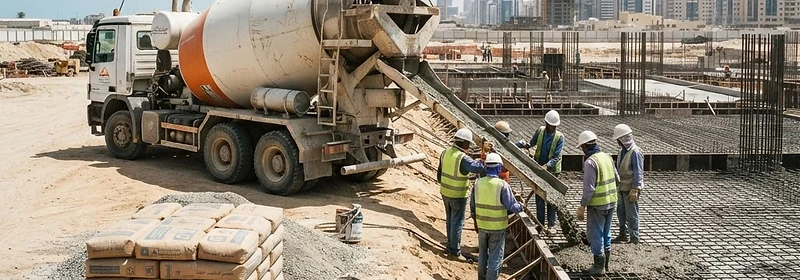
Check the delivery note against the approved mix design, record slump and temperature at discharge, take cubes at the agreed frequency, and reject any truck that arrives outside the time or temperature limit. Every rejected truck is cheaper than a core test failure.
Failures that recur in this climate
Plastic shrinkage cracking from rapid surface drying, usually within hours, prevented by early curing and wind breaks. Thermal cracking in mass pours from the temperature differential between core and surface, controlled by cement replacement and pour sequencing. Honeycombing at congested steel, caused by a slump too low for the spacing rather than by the aggregate. Delamination of toppings and screeds where the base was not saturated or the bond coat was allowed to dry.
Sourcing through Kinetic
Post an inquiry with the mix design, total volume, pour schedule and location. Plants and material traders respond with quotes, and contact details stay locked until you accept a bid.
For the steel and aggregate side of the same package, see our guides to steel rebar sourcing in the Gulf and waterproofing materials for the Gulf climate.
Frequently asked questions
Is CEM I always better than a blended cement? Not for durability or for mass concrete. Blends win on chloride and sulphate resistance and on heat, and lose on early strength and finishing time.
How many cubes per pour? Typically one set per 50 cubic metres or per pour, whichever is more frequent, plus a set for any mix design change. Agree it in the specification rather than on site.
Can I place concrete in August? Yes, with chilled water, retarders, night pours and immediate curing. Placing without those controls is where the defects come from.
Who pays for a failed cube? Who pays is a contract question, so fix it in the specification. Fixing the concrete itself is always the contractor's problem, and the cost of that is far higher than the test.
Source cement, ready-mix and aggregates from verified suppliers on Kinetic.
Related Articles

Gabbro Aggregates in Qatar: Properties, QCS & ASTM Specifications, Sizes & Sourcing Guide
13 Oct 2026

Terrazzo Flooring in Qatar: Types, Specifications & Sourcing Guide
3 Oct 2026

Operable Walls in Qatar: Vertically Retractable Acoustic Partitions for Hotels, Ballrooms and Conference Venues
1 Nov 2026Looking for materials?
Post an inquiry on the Kinetic marketplace and connect with verified suppliers across the Gulf.