

Fixed and Ship Ladders in Qatar: Safe Vertical Access to Roofs, Silos and Tanks
Every building in Qatar that has something on the roof also has a decision to make about how people get up there. In practice that decision is often made late, by whoever is installing the equipment, and the result is a straight ladder bolted to a wall with no cage, no landing and no fall protection. It works until somebody has to use it in the heat at the end of a shift.
This guide covers the two ladders that serve most vertical access in industrial and commercial buildings, the fixed ladder and the ship ladder, the fall protection choices that go with them, the standards to reference in a Qatar specification, and the detailing that keeps galvanised steel working on a Gulf facade.
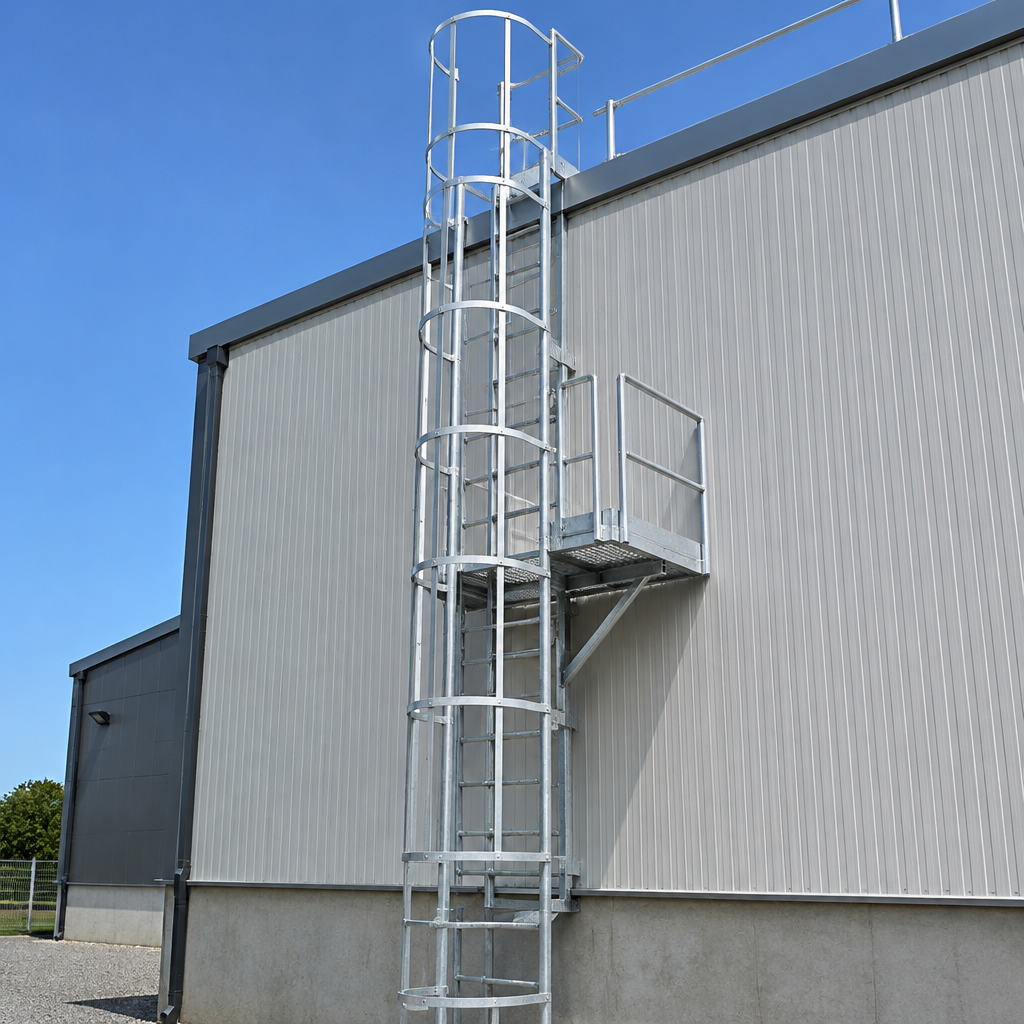
Fixed Ladder or Ship Ladder
The two terms are often used interchangeably on site and they should not be.
A fixed ladder is near vertical, typically at 75 degrees or steeper from horizontal, with rungs rather than treads. It is compact, it suits a narrow wall, and it is uncomfortable and tiring to climb, particularly with tools. Fixed ladders are the default for short climbs and tight spaces.
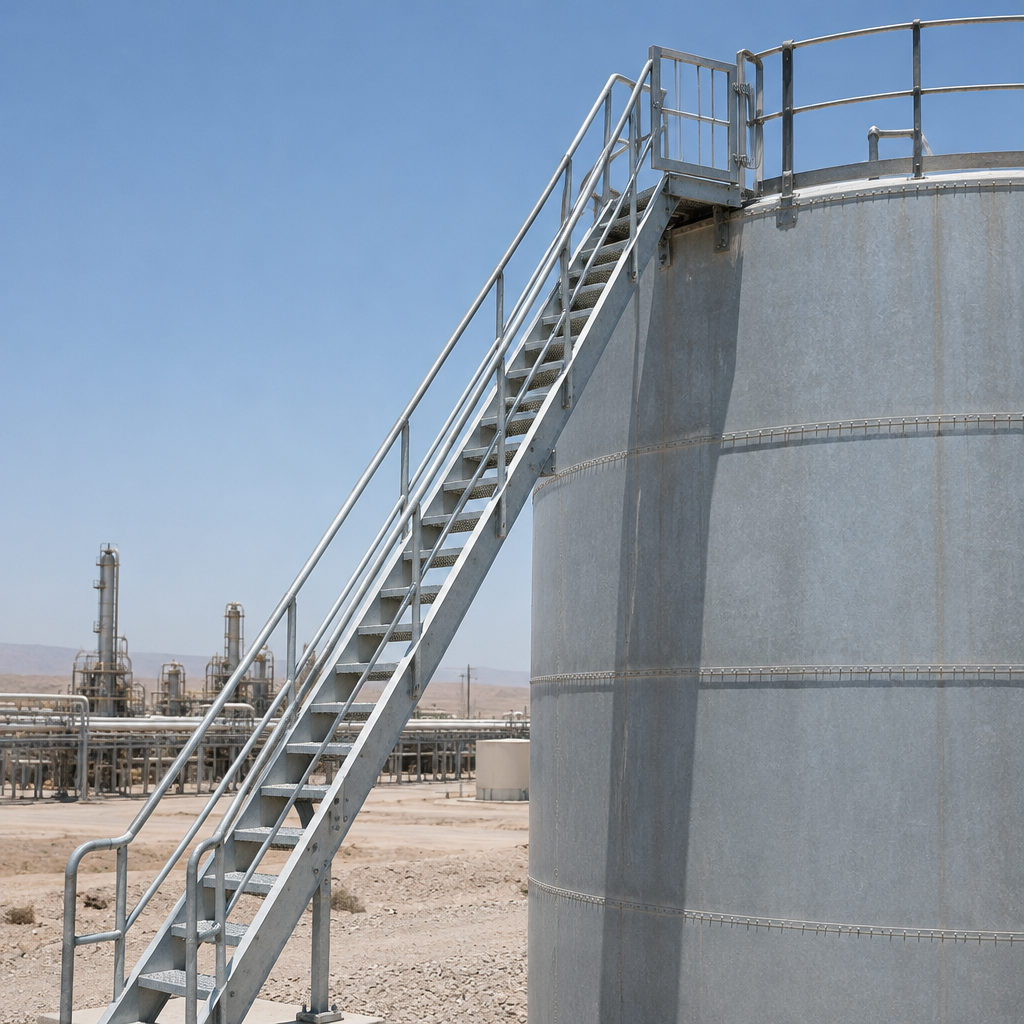
A ship ladder is inclined at a shallower angle, usually around 60 to 75 degrees, with treads rather than rungs and often handrails on both sides. It takes more floor space and more wall length, but it is significantly safer and easier to use, and it is the better choice wherever there is room, especially on plant rooms and tank farms where technicians carry equipment.
There are also companion ladders to a stair, alternating tread ladders for steep spaces, and caged versions of all of them. The choice should follow the height, the frequency of use, and what has to be carried, not the available wall space alone.
Where They Are Used in Qatar
- Roof access for chillers, air handling units, PV arrays, water tanks and lift machine rooms
- Storage silos for cement, aggregates and frac sand, including the valve and level access at the top
- Tank farms and process vessels at refineries and industrial plants
- Water and wastewater treatment structures
- Telecom towers, mast bases and equipment platforms
- Marine and port structures where ladders reach quay furniture or vessel access points
- Warehouses and logistics facilities where mezzanine and roof access is needed
Each of these comes with its own constraint. A silo ladder needs a landing platform at the top and a guard gate at the opening. A tank ladder needs to avoid the shell weld seams and allow for the tank's thermal movement. A roof ladder needs to deliver the user beside a hatch, not into the middle of a membrane field, which is the interface covered in our guide to roof hatches and roof access in Qatar.
Fall Protection: Cage, Lifeline or Rail
Above a certain height, a ladder needs fall protection. There are three accepted approaches, and the choice is a design decision, not a preference.
Safety cage or hoop: the traditional solution. A cage surrounds the climber from a specified height upward and gives a psychological barrier and a physical guide. Modern standards increasingly treat cages as inadequate on their own, because they do not arrest a fall, they only make it harder to fall backward.
Guided type fall arrester on a rigid rail: a rail fixed to the ladder with a trolley that travels with the climber and locks on a fall. This is the most robust solution for tall or frequently used ladders, and it is what international practice is moving toward.
Cable or wire lifeline with a mobile fall arrester: cheaper than a rigid rail and easier to retrofit, acceptable where the ladder is a single straight run and the user is trained and equipped with a harness.
Whichever is chosen, three things must follow: the climber needs a harness that suits the system, the system needs inspection at defined intervals, and the access point needs to be controlled so untrained people do not use the ladder. A fall arrest system nobody wears is decoration.
For tall climbs, the standards also require rest platforms at defined intervals, which in Qatar is not a comfort feature. Climbing 12 metres in 45 degree heat is a genuine physical risk, and a landing every 6 to 9 metres is the difference between an inspection and an incident.
Materials for the Gulf
- Hot-dip galvanised steel to ISO 1461: the default for fixed and ship ladders. Strong, repairable and suited to the climate, provided the fabrication includes vent and drain holes so the inside of hollow sections is coated
- Aluminium: lighter, easier to handle during installation, acceptable inland, but it needs isolation from steel fixings to avoid galvanic corrosion and it is not the answer in a fire affected location
- Stainless steel: the right choice for coastal and marine exposure, and for plants handling chemicals. Grade 316 where chlorides are present
- Rungs and treads: serrated or punched grating treads for grip, with a self-cleaning profile that does not hold sand or water
- Fixings and anchors: stainless steel, with anchor type selected for the substrate, not for the cheapest option in the catalogue
- Coating: paint is for identification and colour. Galvanising is the corrosion protection, and repainting will not compensate for a missing zinc layer
Standards to Reference in a Qatar Specification
- EN ISO 14122-4: fixed ladders as a means of access, including the safety requirements for cages, fall arrest and rest platforms. The most complete practical reference
- EN ISO 14122-3: stairs, stepladders and guard rails, relevant where a ship ladder is treated as an inclined stair
- BS 4211: specification for permanently fixed ladders, widely referenced in UK derived specifications in the Gulf
- OSHA 1910.23: fixed ladders and ladder safety systems, common in US derived project specifications
- EN 1090-1 and 1090-2: execution of steel structures and CE marking of the fabricated ladder and its brackets
- EN 795: anchor devices for fall protection, where anchors are installed for harness use
- QCS 2014: Qatar Construction Specifications for materials and workmanship
- Qatar HSE requirements: Labour Law 14 of 2004 and associated provisions, plus the facility's permit to work system for work at height
One practical caution: the height at which fall protection becomes mandatory, and the acceptable solutions at that height, differ between these standards. Fix the framework in the project specification and apply it consistently across the site, rather than letting each supplier quote to whichever standard suits their product.
Design and Detailing That Decides Safety
- Stand-off brackets: the ladder should be offset from the wall by a consistent distance that allows a foot to fit on the rung and a hand to grip the stringer, typically around 200 mm to the rung centre line
- Top landing: a proper platform with guard rails, toe boards and a self-closing gate at the opening, not a step over a parapet
- Base protection: a hinged barrier, removable section or lockable cover so the ladder cannot be climbed by unauthorised people, which matters on public and school buildings as much as industrial sites
- Alignment with the destination: the ladder must land where the work is, not where the wall was convenient
- Clearance above the landing: enough ladder extension above the platform for a safe handhold when stepping off
- Distance from openings and services: no ladder directly beside a hot pipe, an electrical panel or a moving part
- Structural fixing: brackets anchored to structural elements, with the pull-out capacity calculated for a fall arrest load, not just the ladder's own weight
- Thermal movement: on long ladders and on tanks, the fixing detail must allow for expansion, otherwise the stringer bows and the rungs loosen
- Access control and signage: a sign at the base stating the restriction, and a lock where the site demands it
- Lighting: an inspection at night is as likely as one during the day, and a dark ladder is a fall waiting to happen
Installation, Inspection and Maintenance
Installation is straightforward when the structure is ready and becomes a problem when it is not. Anchor positions should be set out and cast or drilled before fabrication is finalised, and on existing buildings the substrate must be verified, because a ladder anchored into a thin block wall will fail under a fall arrest load even if it looks secure.
A workable inspection routine:
- Quarterly visual: rungs, treads, stringers, brackets and fixings for damage, corrosion and loose bolts
- Annual detailed inspection: anchor integrity, cage or rail alignment, fall arrest device function and certification date
- After any impact or reported fall: out of service until inspected by a competent person
- Galvanising repairs: zinc rich compound on damaged areas, not paint
- Harness and lanyard register: kept with the access point, because equipment in date is part of the system
Frequently Asked Questions
Is a cage required on a fixed ladder in Qatar?
It depends on the height and the standard the project adopts. Many modern specifications accept a guided fall arrester on a rigid rail instead of a cage, and some do not accept cages at all above certain heights. Confirm the framework with the consultant and apply it across the site rather than case by case.
At what height does a ladder need fall protection?
Thresholds vary between standards, commonly between 3 and 6 metres, and some specifications require protection from the first metre on certain risk categories. What matters is that the project fixes one threshold and designs to it consistently.
Fixed ladder or ship ladder for a plant room roof?
If there is wall length available, a ship ladder with handrails is the better experience and the safer choice, especially where tools or parts are carried. A fixed ladder is the fallback for tight spaces and short climbs.
Galvanised or stainless steel ladders for coastal sites in Qatar?
Stainless grade 316 for coastal and marine exposure, hot-dip galvanised steel inland. On sites near Ras Laffan or in Mesaieed, the salt and process atmosphere shortens the life of galvanising significantly, so stainless or a duplex coating system is worth the premium.
Can a ladder be added to an existing building?
Yes, and it is common. The constraints are the substrate for the anchors, the space for stand-off brackets and the landing detail at the top. A survey of the existing structure should precede fabrication, because retrofitting an anchor into an unsuitable wall is the most common failure in these projects.
Conclusion
Vertical access is one of those categories where the cheapest compliant option and the safest practical option are not the same purchase. A cage ladder bolted to a wall may satisfy a drawing, but a ship ladder with handrails, a proper landing and a guided fall arrester is what a technician will actually use comfortably in July.
For projects in Qatar, specify to EN ISO 14122-4, fix the fall protection threshold for the whole site, decide between cage, rail and lifeline on the basis of height and use, and detail the top landing and the base barrier properly. Then inspect on a schedule and keep the harness register at the access point, because the ladder and the equipment worn to climb it are one system.
Post a detailed inquiry on Kinetic to receive quotes from verified suppliers of fixed ladders, ship ladders and fall protection systems in Qatar, or get a contact directly from SRG.
Source fixed ladders, ship ladders and roof access systems on Kinetic.
Related Articles


Roof Hatches in Qatar: Access, Smoke Ventilation, Fire Rating and Specification Guide
31 Oct 2026

Expansion Joint Covers in Qatar: Systems, Specifications, Design & Failure Prevention
12 Oct 2026

Operable Walls in Qatar: Vertically Retractable Acoustic Partitions for Hotels, Ballrooms and Conference Venues
1 Nov 2026Looking for materials?
Post an inquiry on the Kinetic marketplace and connect with verified suppliers across the Gulf.