

Firefighting Equipment Guide for Qatar: Hose, Storz Couplings, Valves, Foam and Nozzles
Firefighting equipment looks like a commodity until the moment it is needed. A hose that fails a pressure test, a coupling that does not match the hydrant, or a valve that cannot be opened under flow becomes a life-safety problem in seconds. In Qatar, every component of a fire protection system must also satisfy Ministry of Interior Civil Defence (QCDD) review, which means equipment selection, documentation and approvals have to be planned together, not after the fact.
This guide walks through the main families of firefighting equipment, what each component does, the standards that apply, and how to specify and source fire equipment for projects in Qatar and the wider GCC. It is based on the product range carried by full-line fire equipment suppliers in the industry.
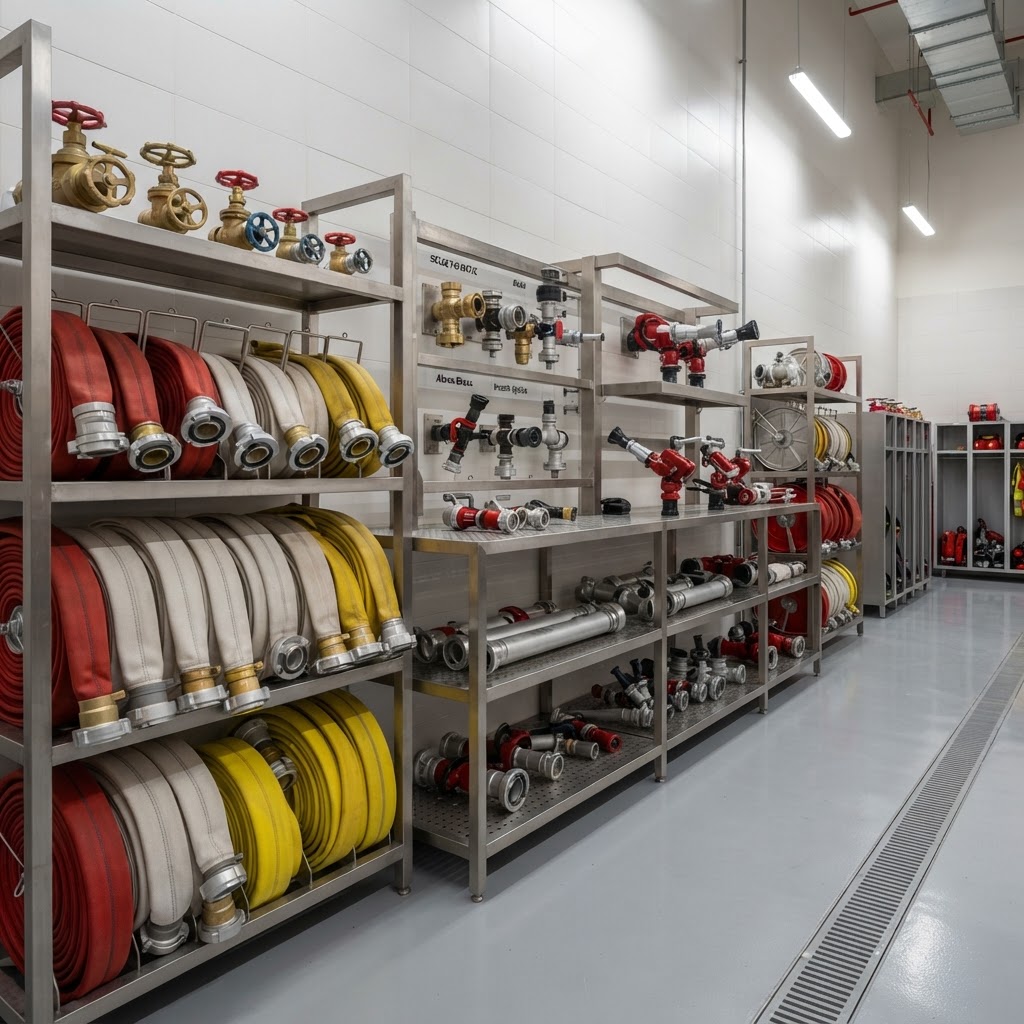
The Main Families of Firefighting Equipment
A full-line fire equipment catalogue typically covers ten product families:
- Fire hose: double jacket, rubber covered, forestry, large diameter supply hose (LDH) and PVC suction hose
- Adapters and fittings: threaded adapters, Storz adapters, caps, plugs, mounting plates, elbows and strainers
- Valves and water supply appliances: hydrant gate valves, LDH ball valves, intake valves, wyes, siamese connections and hydrant accessories
- Foam equipment: foam eductors, nozzles, proportioners and foam concentrates
- Nozzles and monitors: handline nozzles, fixed and portable monitors
- Structural firefighting gear: turnout coats, pants, hoods, gloves, helmets, boots and suspenders
- Portable and scene lighting: helmet lights, personal lights, box lights and portable scene lighting
- Ventilation equipment: battery powered and electric positive pressure ventilators
- Hazardous materials equipment: gas detection and monitoring, air bags, rescue tools
- Tools and wildland equipment: fire hooks, saws, wrenches, wildland hand pumps and forestry tools
Fire Hose: Double Jacket, Rubber Covered and LDH
Attack and supply hose is the backbone of any fire operation.
- Double jacket hose: an all-purpose attack hose with two woven jackets over a rubber lining. It resists abrasion, handles high working pressures and is the default choice for fire attack lines
- Rubber covered hose: an extruded rubber cover over the jacket, which makes the hose more resistant to chemicals, heat and hot embers. It is heavier but tougher, and is common on industrial sites
- Large diameter hose (LDH): supply hose in diameters from 3.5 to 6 inch, used to move large volumes of water between hydrants and apparatus. It has high flow and low friction loss
- Forestry hose: lightweight, packs small, made for wildland and brush work
- PVC suction hose: semi-rigid hose for drafting from open water or tanks
Hose is governed by the NFPA 1961 family of standards, with coupling requirements in NFPA 1962 and NFPA 1963. In Qatar, QCDD expects fire system components to be certified to the referenced standards, so hose test certificates and manufacturer documentation belong in the submittal package from the start.
Storz Couplings and Threaded Adapters
Few things matter more in the field than compatibility between hose, hydrants and inlets.
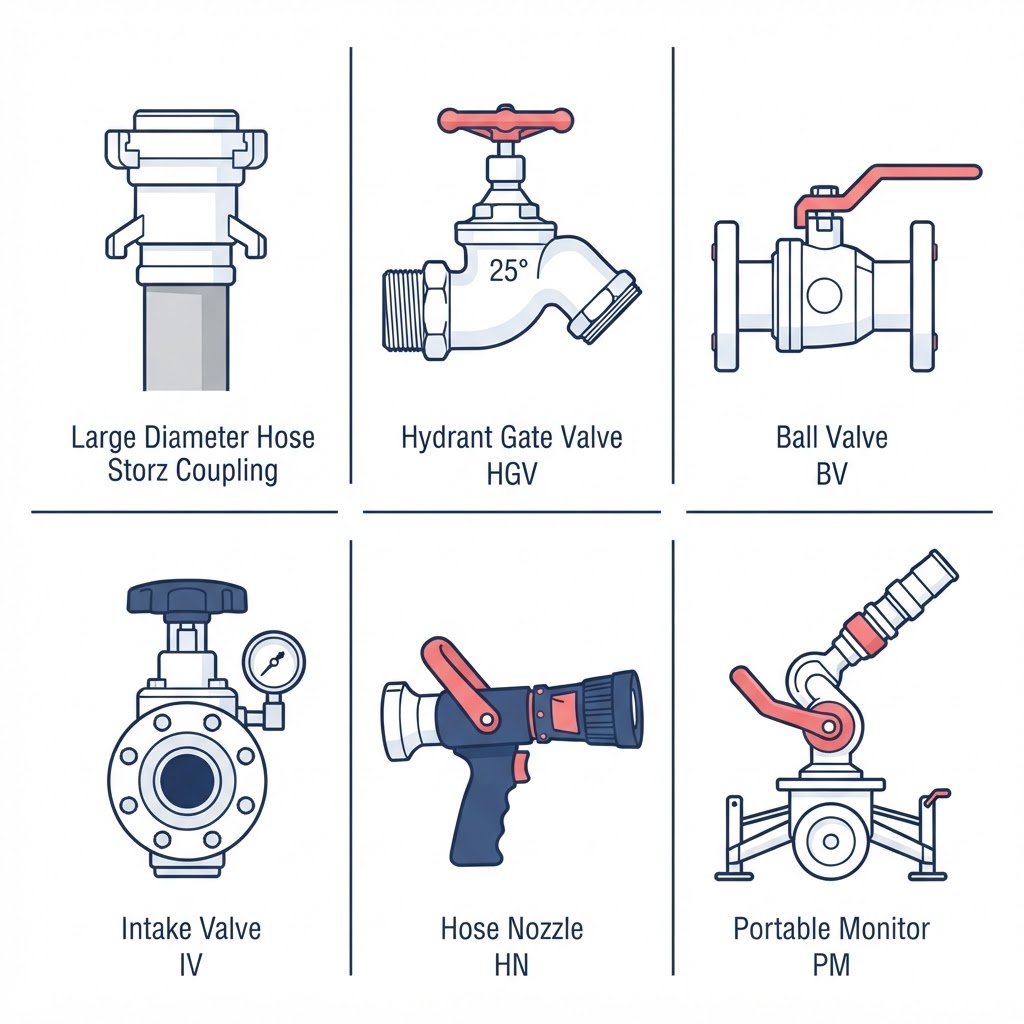
- Storz couplings: a universal, threadless quick connection with interlocking lugs. A quarter turn locks it, and the same coupling connects to any matching size regardless of thread. Storz is the dominant standard for large diameter hose and fire department connections worldwide
- Threaded adapters and NH threads: screw-thread couplings, where NFPA 1963 defines National Hose (NH) dimensions. Threaded connections remain common on 2.5 inch lines and on existing hydrant stocks
- Caps, plugs and mounting plates: protect threads and Storz lugs from damage and debris, and keep inlets clean
In Qatar, the practical lesson for contractors and consultants: confirm the coupling standard of the receiving authority and the site hydrant fleet before ordering, and standardise on adapters so every appliance matches. A mismatch discovered during a civil defence inspection costs far more than an adapter bought in advance.
Valves and Water Supply Appliances
Between the hydrant and the attack line sit the control appliances:
- Hydrant gate valves: LDH gate valves connect to the hydrant outlet and let the operator open and close slowly, bleed trapped air with an air bleeder valve and relieve pressure through an adjustable pressure relief valve. A typical lightweight LDH hydrant gate valve (such as the Harrington H810 pattern with a 25 degree elbow) features a non-rising stem, anodized gate and stainless steel spindle, in a package of roughly 24 pounds
- LDH ball valves: large two-way ball valves (such as the Harrington H600 Super Flow pattern) feed two LDH hoses from a single line or one hose from two lines. Hard anodized balls and stainless steel tappets give corrosion resistance, the waterway design keeps friction loss low, and flow is permitted from either direction
- Intake valves: mounted on apparatus inlets, they control incoming supply and prevent backflow
- Wyes, siamese and hydrants: split or combine lines and anchor the water supply system
Foam Equipment, Nozzles and Monitors
For fuel spills, aircraft rescue, oil and gas terminals and petrochemical plants, water alone is not enough:
- Foam equipment: eductors draw foam concentrate into the water stream at the correct proportion, and foam nozzles aspirate the solution into finished foam
- Nozzles: handline nozzles range from smooth bore tips to automatic fog nozzles with constant flow at variable patterns
- Monitors: fixed and portable monitors flow large volumes from a stable base, and are the standard choice for tank farm and terminal protection
In Qatar's oil, gas and industrial sector, foam systems are among the most inspected parts of a fire protection installation, and the foam concentrate itself must be compatible with the equipment and the hazard. This is an area where equipment selection and the fire engineering design must be developed together.
Structural Firefighting Gear and Personnel Equipment
The personnel side of the catalogue covers turnout gear and the equipment around it:
- Turnout coats and pants certified to NFPA 1971, including custom measured gear and in-stock express programs
- Hoods, gloves, helmets, helmet fronts, goggles and boots
- Gear bags, gear dryers, gear cleaning and contaminant care programs
- Personal lights, helmet lights and portable scene lighting
- Suspenders, rescue rope bags and personal rescue systems
Turnout gear is sized and maintained as a system. Industrial firefighting brigades at energy and industrial facilities in Qatar also specify structural gear with proximity options depending on the hazard analysis.
Ventilation and Hazardous Materials Equipment
- Positive pressure ventilators: battery powered and electric fans that clear smoke from structures. Battery models deploy fast and need no generator on scene
- Gas detection and monitoring: portable instruments for hazardous atmosphere assessment
- Rescue equipment: air bags, stretchers, RIT (rapid intervention team) equipment, rescue tools and hardware
Why the Qatar Context Matters
Qatar's built environment has grown a complete ecosystem that needs firefighting equipment at every level:
- QCDD approval: system designs go through Civil Defence review, and equipment must be on the approved list with valid certification before installation and handover
- Civil defence inspections: commissioning records, test certificates and equipment documentation are reviewed during handover
- Industrial sector: LNG, petrochemical, energy and logistics facilities maintain their own firefighting teams and equipment inventories, often to NFPA frameworks
- New construction: every tower, mall, hospital and warehouse adds hose stations, fire department connections, extinguishers and appliances that must be specified, procured and documented
- Climate: heat and dust accelerate wear on hose jackets, rubber components and electronics, which makes inspection, testing and maintenance (ITM) discipline more important than in temperate climates
Specifying Fire Equipment: A Practical Checklist
- Match the design first: equipment must match the approved fire protection design and the referenced standards (NFPA families for hose, couplings, gear and appliances)
- Confirm QCDD listing: check that each component type has the certification Civil Defence expects, and collect the certificates before submittal
- Standardise couplings: fix one coupling standard across the project and order adapters for any interface with existing hydrants
- Demand documentation: manufacturer datasheets, test certificates, material specifications and installation instructions
- Plan spare parts and ITM: caps, gaskets, spansner wrenches, hose test records and servicing schedules from day one
- Verify sizing and flow: hose diameter, valve size and nozzle flow must match the hydraulic design, not just the connection
Frequently Asked Questions
What does a full firefighting equipment range include?
Fire hose, couplings and adapters, hydrant gate valves and ball valves, foam equipment, nozzles and monitors, turnout gear, portable and scene lighting, ventilators, hazardous materials equipment, hand tools and wildland equipment.
What is a Storz coupling and why does it matter?
Storz is a threadless quick coupling with interlocking lugs that locks with a quarter turn. It is universal within each size, which makes it the standard for large diameter hose and fire department connections, and it eliminates thread compatibility problems.
What is the difference between a hydrant gate valve and an LDH ball valve?
A hydrant gate valve connects to the hydrant and controls flow with slow open and close, air bleeding and pressure relief. An LDH ball valve is a two-way valve that splits or combines large diameter lines with low friction loss and permits flow from either direction.
Which standards govern fire hose and couplings?
The NFPA 1960 series: NFPA 1961 for hose, NFPA 1962 for care and use, and NFPA 1963 for couplings and fittings including NH threads and Storz dimensions.
Does firefighting equipment need Civil Defence approval in Qatar?
Fire protection designs are reviewed by Qatar Civil Defence (QCDD), and equipment used in approved systems must be certified to the referenced standards with documentation available for inspection and handover.
What firefighting equipment does an industrial site need in Qatar?
Beyond fixed systems, industrial sites typically maintain attack and supply hose, LDH appliances, foam equipment, monitors, gas detection, RIT equipment, turnout gear for the site brigade, lighting and ventilation equipment.
How often should fire hose be tested?
NFPA 1962 sets service testing requirements for hose, couplings and nozzles. A documented hose test programme, with records kept for inspection, is standard practice for both civil defence and industrial audit regimes.
Conclusion
Firefighting equipment is a system of matched components: hose, couplings, valves, foam, nozzles and gear that must work together at the moment of use and pass documentation review long before that. In Qatar, the winning approach is to specify to the approved design, standardise couplings early, collect QCDD documentation with the procurement package and plan inspection and testing from the start.
Post a detailed inquiry on Kinetic to receive quotes from verified firefighting equipment suppliers in Qatar, or get a contact directly from SRG.
Related Articles


Steel Structure Fire Protection in Qatar: Intumescent Paint, Boards, Sprays & Concrete Encasement
12 Oct 2026

Tunnel Fire Protection in Qatar: Concrete Spalling, Fire Curves & Protection Boards
12 Oct 2026

Smoke & Fire Curtains: Complete Guide to Standards, Types & Specifications for Gulf Projects (2026)
31 Aug 2026Looking for materials?
Post an inquiry on the Kinetic marketplace and connect with verified suppliers across the Gulf.