

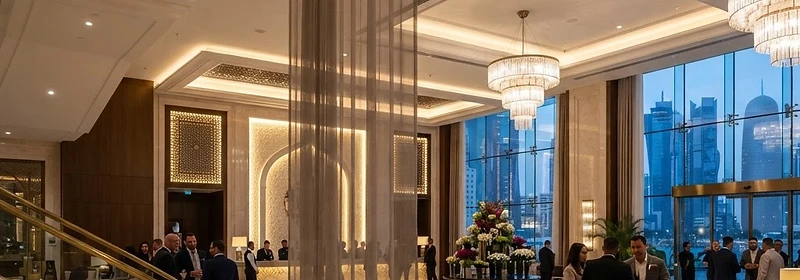
Smoke & Fire Curtains: Complete Guide to Standards, Types & Specifications for Gulf Projects (2026)
Why Smoke and Fire Curtains Matter
Smoke inhalation is the leading cause of death in fire-related incidents. Smoke can travel through a building far faster than fire itself, infiltrating elevator shafts, corridors, and atriums within minutes.
Smoke and fire curtains are deployable barriers made from fire-resistant technical fabrics engineered to withstand extreme heat and block smoke movement. Installed within ceilings, atriums, corridors, or above elevators, these curtains compartmentalize a building during a fire - buying time for evacuation and fire control.
What Is Fire Compartmentalization?
Fire compartmentalization divides a building into distinct fire sectors so fire remains contained within its origin zone. Traditional approaches use firewalls and fire doors. Modern smoke and fire curtains offer a superior alternative - concealed until deployed, preserving architectural openness.
Advantages over firewalls: Architectural flexibility, lightweight construction (fiberglass/silica fabric), concealed deployment, reconfigurable, cost-effective.
How Curtains Work
- Detection - Fire alarm triggers the curtain control unit automatically
- Deployment - Curtains unroll from concealed housing at 6 in/s minimum (NFPA 80)
- Ventilation - Curtains channel smoke toward exhaust systems
- Reversal - Post-emergency, curtains retract into housing
Types of Smoke and Fire Curtains
1. Smoke Curtains (Draft Curtains)
Control smoke movement - don't stop fire directly. Available as static (fixed panels) or automated (deploy from ceiling on alarm). Fabric: fiberglass coated with silicone or polyurethane.
2. Fire Curtains
Heavier barriers that stop flame spread. Fire ratings from 20 minutes to 3 hours.
- Vertical - Drop from ceiling roller. Most common for doorways, corridors, elevators
- Accordion - Fold horizontally for complex layouts and tight corners
- Horizontal - Extend across atrium edges, escalator openings, multi-floor gaps
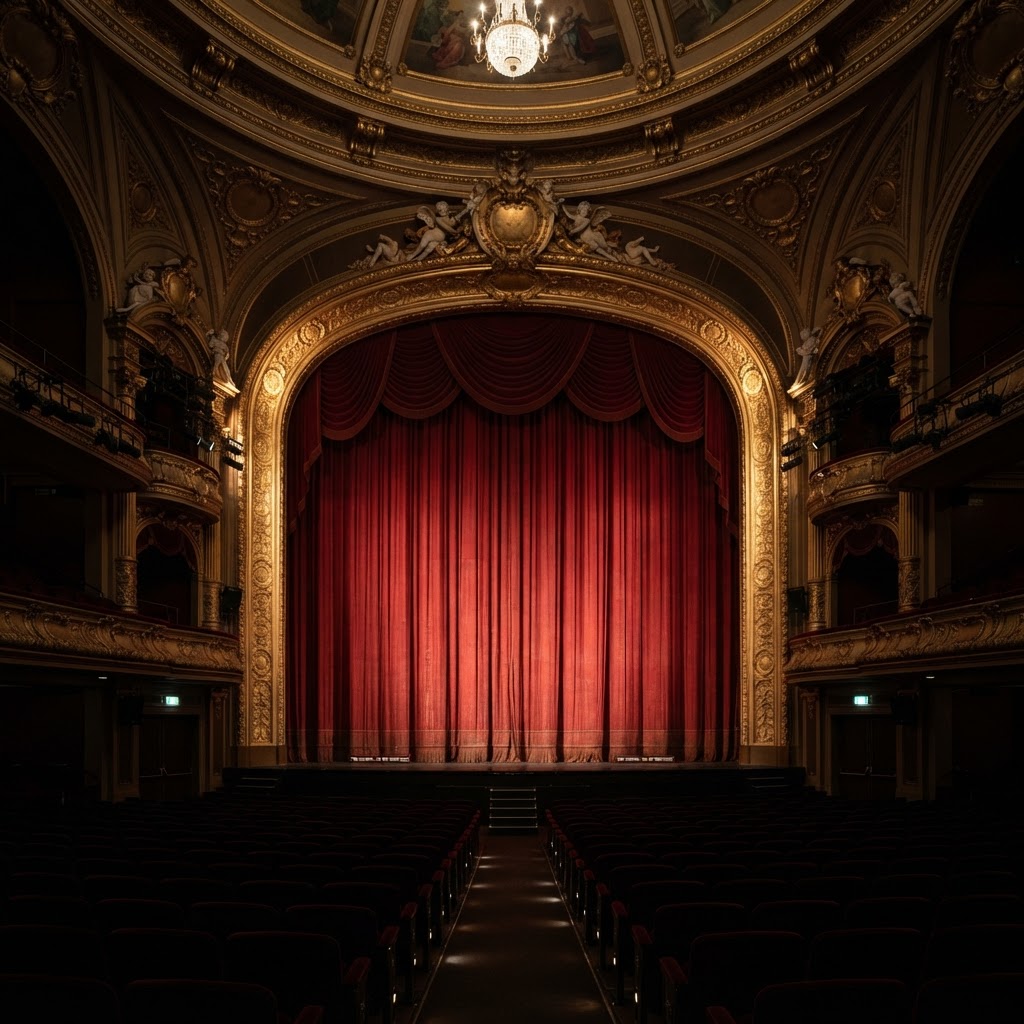 A heavy proscenium fire curtain deployed between stage and audience in a theater auditorium
3. Proscenium Fire Curtains
Heaviest curtain type for theaters and auditoriums. Separate stage from audience. Types: Brail (accordion-folded), Straight Lift (unfolded), Frame Curtain (aesthetic integration). Fabric: texturized glass yarns with vermiculite-coated fiberglass.
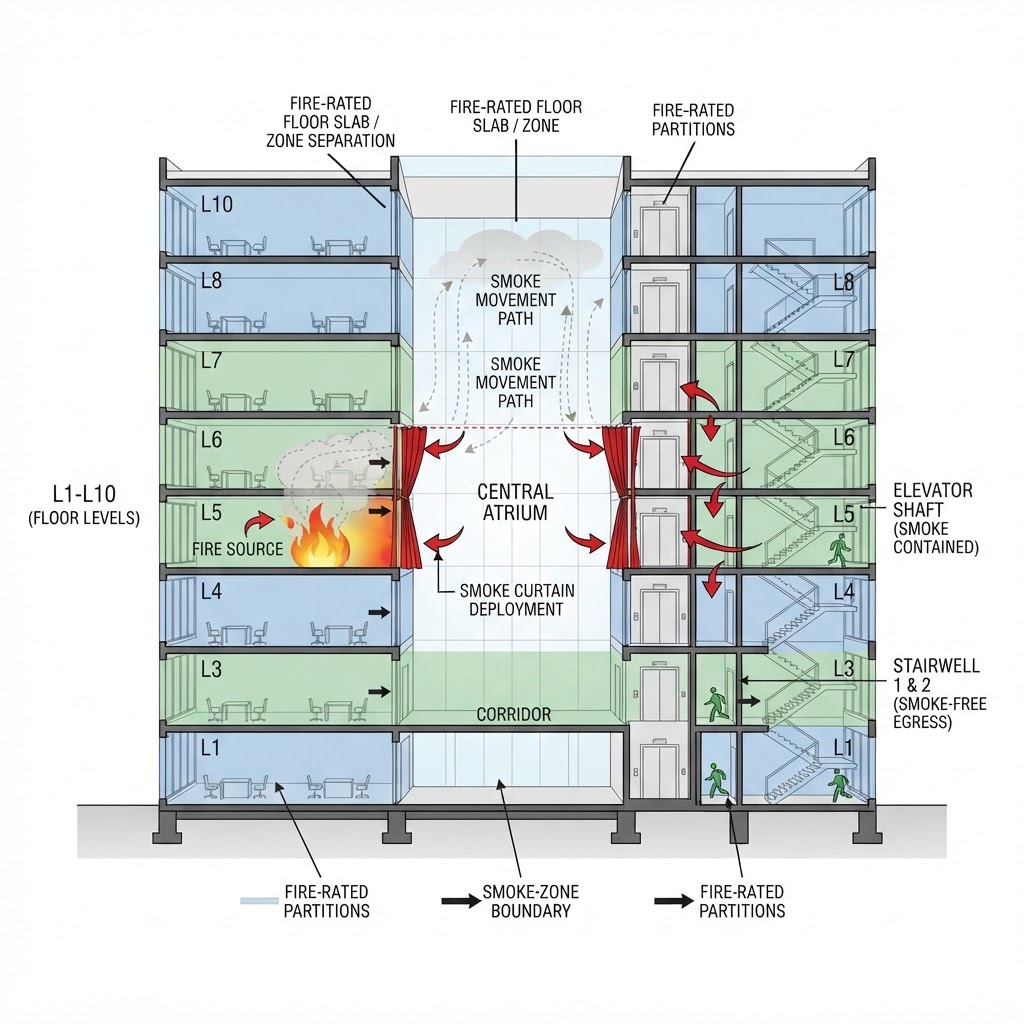 Technical diagram showing fire compartmentalization zones and curtain deployment points in a multi-story building
4. Elevator Smoke Containment Curtains
Prevent smoke from traveling through elevator shafts. Features: magnetic seal edges, seconds deployment, transparent viewing panels, up to 3-hour fire rating.
American Standards for Smoke and Fire Curtains
The United States has a comprehensive set of standards governing the testing, certification, and application of smoke and fire curtains. These are the standards you should specify for projects following American building codes (IBC, NFPA):
UL 10D - Fire Protective Curtain Assemblies
Published in 2014, UL 10D is the primary American standard for testing fire-protective curtain assemblies. It determines the suitability of fire curtains as opening protectives and assigns fire ratings based on fire exposure duration.
Common ratings: 20-minute, 30-minute, 60-minute, 90-minute, and 120-minute.
Key distinction: Unlike ASTM E119, UL 10D does not require the product to limit temperature on the unexposed surface. It focuses on fire penetration resistance and structural integrity during the rated period.
UL 1784 - Air Leakage Tests
UL 1784 evaluates the air leakage performance of door assemblies and opening protectives, including curtain assemblies. It measures the ability of the curtain to limit the passage of smoke and air under pressure differential.
Why it matters: A curtain that holds back fire but allows smoke to pass through fails its primary life-safety function. UL 1784 ensures the curtain provides a genuine smoke seal, not just a thermal barrier.
ASTM E119 / UL 263 - Fire Endurance Tests
ASTM E119 (and its UL equivalent, UL 263) is the standard test for fire endurance of building materials and assemblies. It measures how long a barrier can contain a fire while maintaining structural integrity and limiting temperature rise on the unexposed surface.
Significance for curtains: Curtains tested to ASTM E119 provide full fire-resistance-rated protection, including both integrity (E) and insulation (I) performance - meaning they limit heat transfer to the protected side.
NFPA 80 - Standard for Fire Doors and Other Opening Protectives
NFPA 80 governs the installation, inspection, testing, and maintenance of fire doors, fire shutters, and - since the 2016 edition - fire curtains. Chapter 20 specifically addresses fire curtain assemblies.
Key requirements:
- Annual operational testing and inspection by qualified personnel
- Minimum closing rate of 6 inches per second
- Maximum closing rate to prevent injury to occupants
- Detailed maintenance records maintained by building owners
- Testing after any modification or repair
NFPA 105 - Standard for Smoke Door Assemblies
NFPA 105 prescribes minimum requirements for smoke door assemblies and equivalent opening protectives. When a curtain serves as both a fire and smoke barrier, it must comply with both NFPA 80 and NFPA 105.
Key requirements:
- Smoke leakage performance tested per UL 1784
- Automatic closure upon fire alarm signal
- Compliance with building code smoke barrier ratings
Additional American Test Standards
| Standard | What It Tests | |---|---| | ASTM E-84 | Surface flame spread and smoke generation | | ASTM D6413 | Vertical flame resistance | | ASTM F-955 | Molten metal splash resistance | | ISO 12236 | Structural durability and puncture strength | | BSS 7239 | Non-toxicity of combustion byproducts | | FAR 25 Appendix F | Flame penetration and smoke control (FAA) |
European Standards for Smoke and Fire Curtains
European standards follow a different classification system, based on performance criteria rather than time-based ratings alone. These are the standards to specify for projects following European building codes (Eurocodes):
EN 1634-1 - Fire Resistance Tests for Doors and Shutters
EN 1634-1 is the European standard for testing fire resistance of door and shutter assemblies, including fire curtain systems. It tests the curtain under standardized fire conditions and classifies its performance.
Classification system:
E (Integrity) - The curtain maintains its ability to prevent the passage of flames and hot gases for the rated duration. Example: E-120 means integrity for 120 minutes.
EW (Integrity + Radiation) - The curtain maintains integrity AND limits radiation on the unexposed side to below critical levels. Example: EW-120 means integrity plus radiation control for 120 minutes.
EI (Integrity + Insulation) - The highest classification. The curtain maintains integrity AND limits temperature rise on the unexposed surface. Example: EI-180 means integrity plus insulation for 180 minutes.
| Classification | Performance | Typical Rating | |---|---|---| | E | Integrity only | 30, 60, 120 minutes | | EW | Integrity + radiation control | 60, 120 minutes | | EI | Integrity + insulation | 60, 120, 180 minutes |
Which classification to choose:
- E-rated - Sufficient where the protected area has no combustible materials and no occupants
- EW-rated - Required where radiation heat could ignite materials on the protected side
- EI-rated - Required where the curtain separates occupied areas and full thermal insulation is needed for safe evacuation
EN 13501-1 - Reaction to Fire Classification
EN 13501-1 classifies construction products based on their reaction-to-fire characteristics. For smoke and fire curtains, the relevant classification is:
A2 s1 d0 - The highest practical classification for textile-based curtain systems:
- A2 - No significant contribution to fire load
- s1 - No or negligible smoke production
- d0 - No flaming droplets or particles
This classification is mandatory for curtains installed in escape routes and critical compartmentalization applications under European building codes.
BS 8524 - Active Fire Curtain Barrier Assemblies (UK)
BS 8524 is the UK-specific standard for active fire curtain barrier assemblies. It is more comprehensive than EN 1634-1 because it covers the entire system - not just the fabric barrier, but also the control units, deployment mechanisms, and installation.
Part 1 - Specifies requirements for the design, testing, and classification of active fire curtain barrier assemblies. Covers the curtain itself, the housing, the control system, and the deployment mechanism.
Part 2 - Covers the practice of application, installation, commissioning, and maintenance. No physical fire testing, but ensures proper on-site implementation.
Key BS 8524 requirements:
- Fail-safe deployment (curtain deploys even if power fails, via gravity or battery backup)
- 1,000+ operational cycle testing
- Smoke impermeability at 25 Pa pressure (maximum 0.003 m3/h leakage)
- Quarterly maintenance and annual technical inspections
- Detailed documentation of each inspection and test
Other International Standards
ISO 21524:2021 - Fire Resistance Tests for Active Fire Curtains
ISO 21524:2021 is the international standard that specifies requirements for the design, testing, and classification of active fire curtains. It is material-independent - applicable to any curtain type regardless of fabric composition. It outlines detailed procedures for maintenance and operation verification.
BS 9999 - Code of Practice for Fire Safety in Buildings
BS 9999 is the UK code of practice that sets out that fire curtains should be tested to BS 8524. Some fire curtains may alternatively be tested to BS EN 16034, though UK test houses have historically rejected EN 16034 for fire curtain applications, making BS 8524 the dominant standard in the UK market.
Standards Comparison: American vs European
| Feature | American (UL/NFPA) | European (EN/BS) | |---|---|---| | Fire rating | Time-based (20-180 min) | Classification-based (E, EW, EI) | | Smoke leakage | UL 1784 | EN 1634-3 / EN 13501-1 | | Installation & maintenance | NFPA 80 (annual) | BS 8524-2 (quarterly) | | Closing rate | 6 in/s minimum | Varies by standard | | Fail-safe | Required | Required (gravity/battery) | | Material classification | ASTM E-84 | EN 13501-1 (A2 s1 d0) | | Cycle testing | Not specified | 1,000+ cycles |
Applications
- Hotels - Elevator shafts, atriums, event rooms, corridors
- Commercial - Open-plan offices, stairwells, lobbies
- Malls - Atrium openings, food courts, corridor intersections
- Healthcare - Evacuation routes, pharmacies, operating theaters
- Airports - Concourses, escalator openings, baggage areas
- Industrial - Storage zones, loading docks, manufacturing floors
- Theaters - Proscenium openings, back-of-house, orchestra pits
Specifying for Gulf Projects
Regulatory: Qatar Civil Defense (QCDD), Qatar Construction Specifications (QCS), local civil defense approvals, international standards compliance (American or European per project spec).
Climate: 50C+ ambient rating, corrosion-resistant housings (316L stainless/anodized aluminum), IP54 dust sealing.
Integration: BMS monitoring, fire alarm auto-deploy, smoke extraction coordination, UPS backup (30 min min).
What to Include in Your Inquiry
- Application area and opening dimensions (WxH in mm)
- Required standard (American: UL 10D/NFPA 80 or European: EN 1634-1/BS 8524)
- Fire rating (minutes) or classification (E/EW/EI)
- Deployment type (vertical, accordion, horizontal, brail)
- Control system, power supply (230V/50Hz), housing finish
- Quantity and timeline
How to Source Through Kinetic
Post a detailed inquiry on Kinetic by SRG Solutions (www.srg-solutions.org) with your curtain type, standards, and dimensions. Verified suppliers submit technical proposals. Compare side-by-side, accept the best fit.
Visit www.srg-solutions.org to post your inquiry. Free for contractors.
SRG Solutions supplies fire and smoke curtain systems - vertical fire curtains, smoke control curtains, elevator containment curtains, proscenium curtains, and control units - compliant with American (UL 10D, NFPA 80/105) and European (EN 1634-1, BS 8524) standards across Qatar and the Gulf.
Looking for materials?
Post an inquiry on the Kinetic marketplace and connect with verified suppliers across the Gulf.
Post an Inquiry