
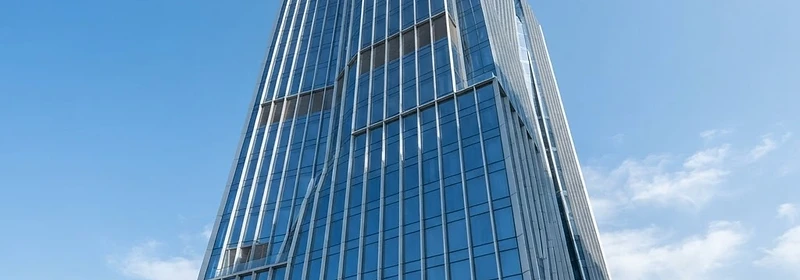
Glass and Aluminium Facade Systems for Gulf Architecture
The facade is the largest single interface between a building and a climate that punishes it. In Qatar it must reject solar heat, resist wind and salt, survive thermal movement across a 40 degree daily swing, and still look right. This guide covers the system types, the performance numbers that decide energy use, the testing that proves a system works, and the finishing standards that separate a facade that lasts from one that stains.
System types
Stick curtain wall
Aluminium mullions and transoms assembled on site with glazing installed afterwards. Economic for low rise, complex geometry and small quantities. Installation quality depends heavily on site supervision, because every interface is made in the field.
Unitized curtain wall
Factory assembled panels with glazing, gaskets and often insulation complete, then hung on site. This is the default for towers: faster, more consistent, and better sealed. The trade off is earlier design freeze and higher up front engineering.
Structural glazing
Four sided or two sided silicone bonded systems where the glass is held by adhesive rather than visible pressure plates. Requires a structural silicone design, adhesion testing on the actual substrate, and an ETA or equivalent assessment.
Aluminium cladding and louvres
Solid aluminium, composite panels, perforated and extruded louvres for shading and plant screening. Louvres are also the most common place to hide a maintenance access route badly.
Performance numbers that actually drive energy
| Property | Target for Qatar | |---|---| | Solar heat gain coefficient | 0.25 or lower on sun exposed elevations | | U-value of the glazed assembly | 1.8 W/m2K or better, 1.3 for premium | | Visible light transmission | 30 to 50 percent, balancing daylight against glare | | Coating | Double or triple silver low-E | | Condensation resistance | Checked against internal humidity, not just external temperature |
Glass selection is a balance, not a maximum. A very low solar factor with very low light transmission produces a dark interior and higher lighting load, which is often the wrong trade for offices and schools.
Wind, water and structural testing
- Design wind pressure from the project wind study, applied to EN 1991-1-4 or the local code
- Air permeability, water tightness and structural performance tested to CWCT or AAMA sequences
- Mock up testing with the project consultant present, before any production panel is released
- Movement accommodation for slab deflection, thermal expansion and seismic drift
- Impact and safety glazing where required, plus blast or security glazing on protected assets
The mock up is not a formality. Almost every serious facade failure in this region was visible in the mock up and signed off anyway.
Aluminium finishing for coastal conditions
- Alloy 6063 T5 or T6 for extrusions, with wall thickness to the structural design
- Powder coating to Qualicoat class 2 as a minimum, class 3 for severe coastal exposure
- PVDF coating where colour retention over decades matters
- Anodising with a defined thickness, typically 20 to 25 microns
- Thermal break between inside and outside profiles, mandatory for condensation control
- Galvanic separation between aluminium and steel fixings
The facade is part of the building envelope rather than a separate item, so read it alongside the building envelope protection guide. Where the facade design includes operable louvres or natural ventilation openings, the natural ventilation and daylighting guide covers the controls and the coordination with smoke strategy.
Installation and sealing
- Set out from a surveyed datum, not from the slab edge
- Use structural silicone with adhesion testing on every substrate batch
- Keep gaskets continuous and correctly cornered, cut corners are where water enters
- Provide drainage paths within the system, with weeps that are not sealed by mistake
- Protect finished aluminium from cement and cleaning acids during the rest of the build
- Clean with pH neutral products only, acid cleaning etches the finish permanently
Frequently asked questions
Unitized or stick for a 20 storey tower? Unitized, for programme and quality consistency.
Is low-E coating enough in Qatar? It is necessary but not sufficient. Solar factor, frame thermal break and shading all contribute.
How often should a facade be inspected? Annually for sealant and drainage, with a full condition survey every five years.
Sourcing facade systems, glazing or aluminium profiles for a Gulf project? Post the performance requirements on Kinetic and compare verified supplier quotes.
Related Articles

Loading Access Platforms in Qatar: Stairs, Racks and Gangways for Safe Tanker and Railcar Transfer
31 Oct 2026

Spill Containment in Qatar: Track Pans, Berms, Pallets and Secondary Containment
31 Oct 2026
Grounding, Overfill Protection and Metering at Qatar Fuel Terminals
31 Oct 2026Looking for materials?
Post an inquiry on the Kinetic marketplace and connect with verified suppliers across the Gulf.