

Loading Access Platforms in Qatar: Stairs, Racks and Gangways for Safe Tanker and Railcar Transfer
Every bulk terminal in Qatar has the same quiet problem standing in the middle of it: a driver or operator has to get up to the top of a tanker, a railcar or a hopper to open a hatch, connect a loading arm or take a sample. The equipment that gets them there safely is a loading access system, and it is the single most under-engineered purchase in a terminal after the loading arm itself.
Falls from height remain the leading cause of serious injury in bulk handling worldwide, and loading operations concentrate the risk: routine work, multiple vehicles, shift changes, heat, and a height of between one and three metres that feels harmless until it is not. In Qatar the ambient temperature adds fatigue and hand sweat to the equation, and a handrail that is not there becomes a decision nobody should be asked to make at the end of a shift.
This guide covers the access equipment that belongs at a bulk terminal, the materials that survive Gulf conditions, the standards to reference in a Qatar specification, and the design details that decide whether the structure is used or bypassed.
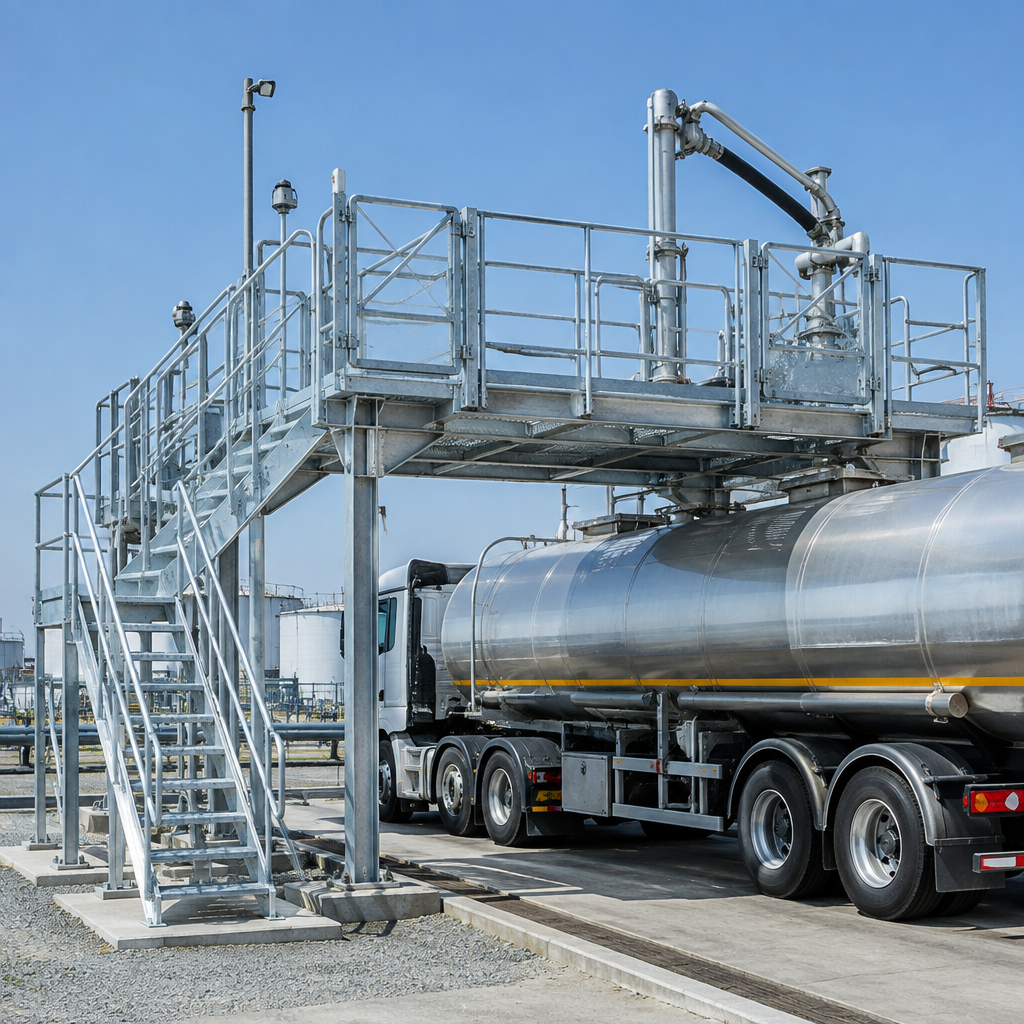
What Loading Access Actually Includes
The category is broader than most specifications acknowledge. At a working terminal it usually embraces:
- Fixed industrial stairs: the primary route to a loading rack or platform, designed to a consistent rise and going rather than site-convenient steps welded from offcuts
- Loading racks and elevated platforms: the structure that gives the operator a stable standing position beside the vehicle's hatch or dome
- Crossover stairs: bridges over pipe runs, conveyors and bund walls so the operator never steps over an obstacle with a hose in one hand
- Rolling and mobile stairs: repositionable access for fleets of trucks that are not served by a fixed rack
- Fixed and ship ladders: access to vessels, silos, tanks and roof structures, including the ship ladder option on roofs
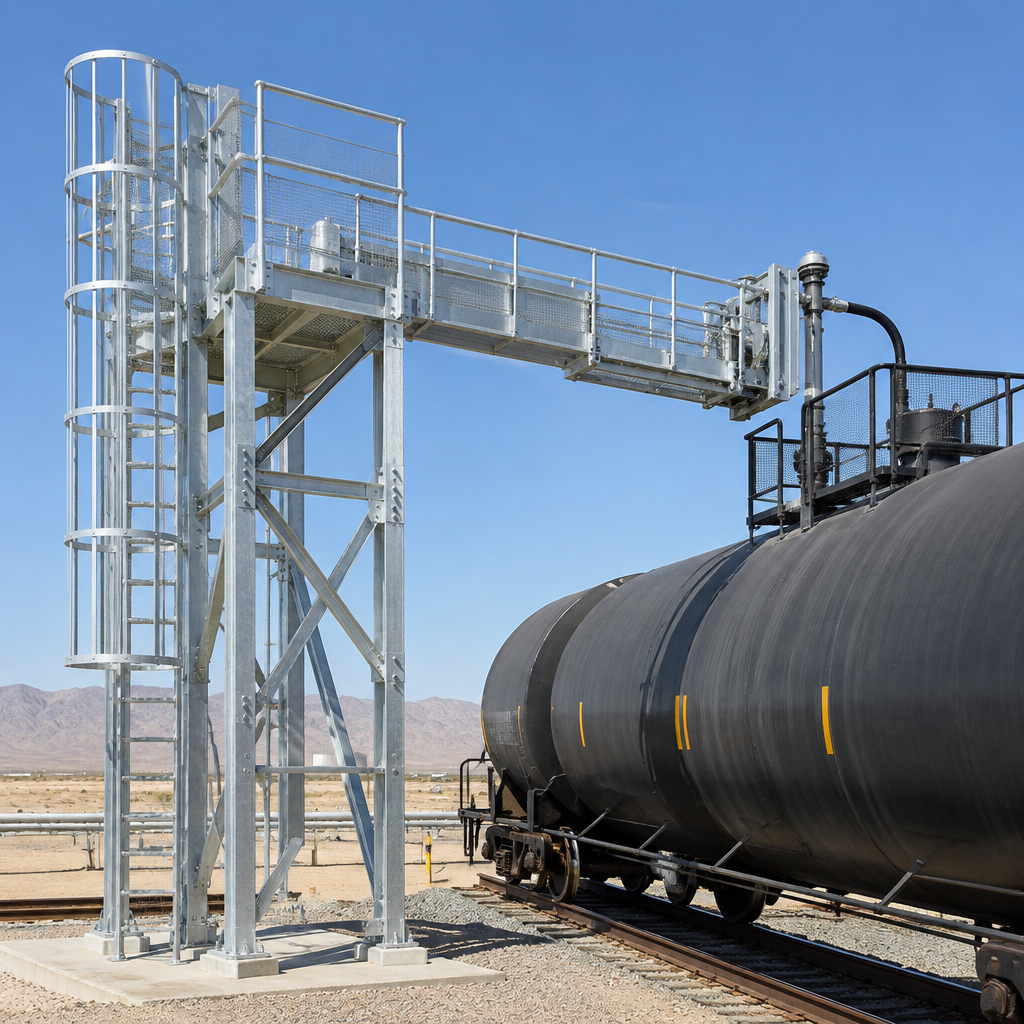
- Gangways: the adjustable bridge to a railcar, truck or marine vessel, with a safety cage at the outer end
- Safety gates and handrails: the passive components that make all of the above work as a system rather than a set of hazards
Truck Versus Railcar Versus Marine
The three modes impose different geometry and different risk:
Truck loading is the most common in Qatar: fuel, water, aggregates, cement, chemicals and bitumen. Truck deck heights vary by tanker design, so the platform is normally set to a standard loading height with a gangway or a short step-over that accommodates the range. Traffic management matters as much as steel: a platform in the wrong place turns a docking manoeuvre into a reversing hazard.
Railcar loading is lower volume in Qatar but critical at bulk chemical and cement facilities, where the rail tank car dome platform is generally higher and further from the loading structure. Dedicated railcar gangways with integrated safety cages are the standard answer, and they need to reach the dome platform without the operator leaning out.
Marine access at Hamad Port and the industrial ports involves gangways to barges, workboats and near shore craft, where tide range and vessel movement govern the design. Marine gangways need a self-levelling or floating end, handrails on both sides, and a cage or fall arrest arrangement where the drop is into water or onto the quay.
Materials and Finishes for Gulf Conditions
The default answer is hot-dip galvanised steel to ISO 1461, and it is usually the right one.
- Hot-dip galvanised carbon steel: strong, repairable, suited to hot climates, and the finish that survives most industrial exposure. The key detail is drainage: hollow sections and welded assemblies must have vent and drain holes so the molten zinc coats the inside, otherwise the structure rusts from the inside out
- Aluminium: lighter and preferred for mobile and rolling platforms, but it needs care at bolt interfaces with steel because of galvanic corrosion and requires stainless isolation washers
- Stainless steel: justified at chemical terminals and in coastal marine exposure, expensive elsewhere
- Ductile iron or cast components: used on railcar stops, chocks and heavy-duty hinges
- Gratings and decking: hot-dipped galvanised steel grating or anti-slip plate. Sand accumulates in grating as in every other void in Qatar, so specify a grating with a depth that can be cleaned and plan for compressed-air blowdown
- Coating systems: powder coating and paint give colour and visibility, but only galvanising gives lasting corrosion protection. Where colour matters, specify a duplex system rather than paint alone
Standards and Compliance for a Qatar Specification
A submittal that survives review will reference:
- EN ISO 14122-1 to -4: safe access to machinery, covering the choice of access, working platforms, stairs and fixed ladders. This is the most practical framework for loading structures and the one most consultants accept
- EN ISO 14122-4 and BS 4211: fixed and ship ladders, including fall protection on ladders above the specified height
- EN 1991 and EN 1993: actions and steel design, including wind and imposed loads
- EN 1090-1 and 1090-2: execution of steel structures and CE marking, which increasingly appears in Qatari submittals
- QCS 2014: the Qatar Construction Specifications for materials and workmanship, plus the project structural specifications where the client is Ashghal
- Qatar HSE requirements: Labour Law 14 of 2004 and the associated ministerial HSE provisions, plus the operator's own permit to work system
- NFPA 30 and 77 where fuel and combustible liquids are involved, since these set the separation and bunding context in which the platform sits
Design Details That Decide Whether It Gets Used
Access equipment is only effective if it is easier to use than the unsafe alternative. A few design decisions separate a proper installation from a steel structure nobody trusts:
- Self-closing safety gates at the point of transfer, not an open end with a chain and a sign
- Handrails at 1100 mm with toe boards, continuous around the platform, including the loading side where the operator leans toward the vehicle
- A fall distance of zero: the platform deck should be within a step of the vehicle hatch, not 400 mm above it
- Gangway reach that matches the fleet, including the tallest and widest vehicle that will ever arrive, not the average one
- Counterbalanced or gas strut assisted movement on any adjustable section, because manual lifting fails in the afternoon heat
- Drainage and wash-down: platforms hold drilling mud, sand and product residue. Open profiles and removable sections beat sealed boxes
- Bonding and grounding points integrated into the rack, since every fuel or chemical transfer requires earthing and the connection point should be at the platform, not on the ground
- Lighting: most bulk transfer in the Gulf starts early and runs into darkness. Lighting at the platform, not at ground level
- Shade or canopy where the process allows it. A loading rack that provides shade is used correctly, a rack that bakes the operator invites shortcuts
- Signage and vehicle stops coordinated with the structure, so the vehicle stops where the platform is, every time
Coordination With the Rest of the Terminal
The loading access structure does not stand alone. It has to coordinate with the loading arm and the metering skid, with the weighbridge and gate flow, with the fire water and foam system, and with the electrical earthing arrangement. On a fuel depot that coordination is usually governed by the terminal's operating philosophy rather than by any single contractor.
Two practical interfaces are commonly missed. First, the railcar stop or derail position must align with the platform, because a railcar that stops two metres short makes a fixed platform unusable. Second, the transition from the access structure to the roof of a building or a tank top must be closed off properly, which is the same discipline we describe in our guide to roof hatches and roof access in Qatar. A gap between two compliant structures is still a fall.
Existing terminals also need periodic structural repair, and where a platform has been hit by a vehicle or a railcar, the fix is usually a fabrication and welding job rather than a replacement, in the same way that on-site machining keeps critical plant in service without dismantling it, as covered in our guide to on-site machining and mechanical repairs in Qatar.
Installation and Site Sequencing
Most loading access disputes trace back to site sequencing:
- Foundations or slab anchors need to be cast before the structure is fabricated, since a rack designed to a survey that was never repeated will not fit
- On live terminals, installation is planned around loading windows, and hot work permits govern welding and cutting
- Galvanised surfaces damaged during installation are repaired with a zinc-rich compound, not paint
- Bolt torque and anchor certification should be documented, because a fall protection structure is only as good as its anchor
- Commissioning includes a physical test of every gate, spring and counterbalance, plus a trial with the actual vehicle type that will use it
Inspection and Maintenance
A loading access structure earns its keep through routine inspection, tied to the permit to work system rather than to convenience:
- Monthly visual inspection of handrails, gates, gratings and toe boards for damage and corrosion
- Annual structural inspection of fixings, anchors, welds and galvanising condition
- Function test of self-closing gates and counterbalance mechanisms every quarter
- Confirmation that fall arrest equipment used from the structure is inspected and in date
- After any vehicle or railcar impact: out of service until inspected, not "we will look at it later"
Frequently Asked Questions
Is a fall protection system required on a loading rack in Qatar?
Qatar's HSE framework and the operating licence conditions of most industrial facilities require protection against falls from height, and loading racks are one of the specified locations. In practice the hierarchy is passive first: handrails and gates, then fall arrest or restraint where passive protection is not possible.
Galvanised steel or aluminium for a loading platform in Qatar?
Galvanised steel for fixed structures, aluminium for mobile and rolling platforms where weight matters. Both work in the climate, but galvanising to ISO 1461 gives a longer service life on a fixed rack and is easier to repair after impact.
How high should a truck loading platform be?
It follows the deck height of the tankers or trailers in the fleet, with the aim that the operator steps across to the hatch rather than climbing up or down. Measure the actual fleet before finalising the drawing, because a platform designed to a catalogue dimension is the most common cause of a rack that never gets used.
Do I need a gangway or a set of stairs?
If the vehicle deck is at or close to the platform level, stairs plus a short step-over are enough. If the vehicle deck varies, sits higher or is reached across a gap, a gangway with an integrated safety cage is the safer answer and usually the cheaper one over the asset life.
Can loading access be retrofitted to an existing terminal?
Yes, and it is common in Qatar. The constraints are foundations, available footprint and the operating window for installation. A modular galvanised system fabricated off site and bolted down usually beats a welded bespoke structure on a live terminal, because it limits hot work and downtime.
What documentation should come with the structure?
Structural calculations, material and galvanising certificates, anchor and bolt certification, as-built drawings, the maintenance manual, and the inspection routine. Without the as-built and the calculations, the asset cannot be verified during a safety audit.
Conclusion
Loading access is where a terminal's safety culture becomes visible. Handrails, gates, stairs and gangways are inexpensive relative to the product flowing through the facility, yet they decide whether an operator steps safely to a hatch or climbs a tanker with one hand on a rail that was never designed for the job.
For projects in Qatar, specify the access system as engineering rather than as a fabricated accessory: EN ISO 14122 as the framework, hot-dip galvanising to ISO 1461 for the environment, self-closing gates and continuous handrails as standard, and sizing taken from the actual fleet and railcars rather than from a brochure. Then inspect it on a schedule, because a compliant structure that nobody checks stops being compliant quietly.
Post a detailed inquiry on Kinetic to receive quotes from verified suppliers of loading platforms, access stairs and gangways in Qatar, or get a contact directly from SRG.
Source loading access platforms, gangways and safety gates on Kinetic.
Related Articles


Spill Containment in Qatar: Track Pans, Berms, Pallets and Secondary Containment
31 Oct 2026
Dock Equipment in Qatar: Levelers, Vehicle Restraints and Loading Bay Safety
31 Oct 2026

Fall Protection at Loading Bays in Qatar: Safety Gates, Handrails, Lifelines and Harnesses
31 Oct 2026Looking for materials?
Post an inquiry on the Kinetic marketplace and connect with verified suppliers across the Gulf.