


Spill Containment in Qatar: Track Pans, Berms, Pallets and Secondary Containment
Secondary containment is the least glamorous purchase on any industrial site and the first thing an environmental inspector asks about. The principle is simple: if the primary container fails, whether that is a tanker, a railcar, a drum or an IBC, the contents must be caught before they reach the ground, the drainage system or the sea.
In Qatar the requirement has weight beyond compliance paperwork. Much of the industrial base sits on shallow, highly permeable ground with a high water table, and sites at Ras Laffan, Mesaieed and the ports discharge into a marine environment that is both ecologically sensitive and economically central. A spill that reaches groundwater or the Gulf is not a cleanup problem, it is a regulatory and reputational event.
This guide covers the containment products that do the work, the capacity rules to apply, the materials that survive a Gulf summer, and the practical detailing that decides whether containment actually contains.
The Four Families of Containment
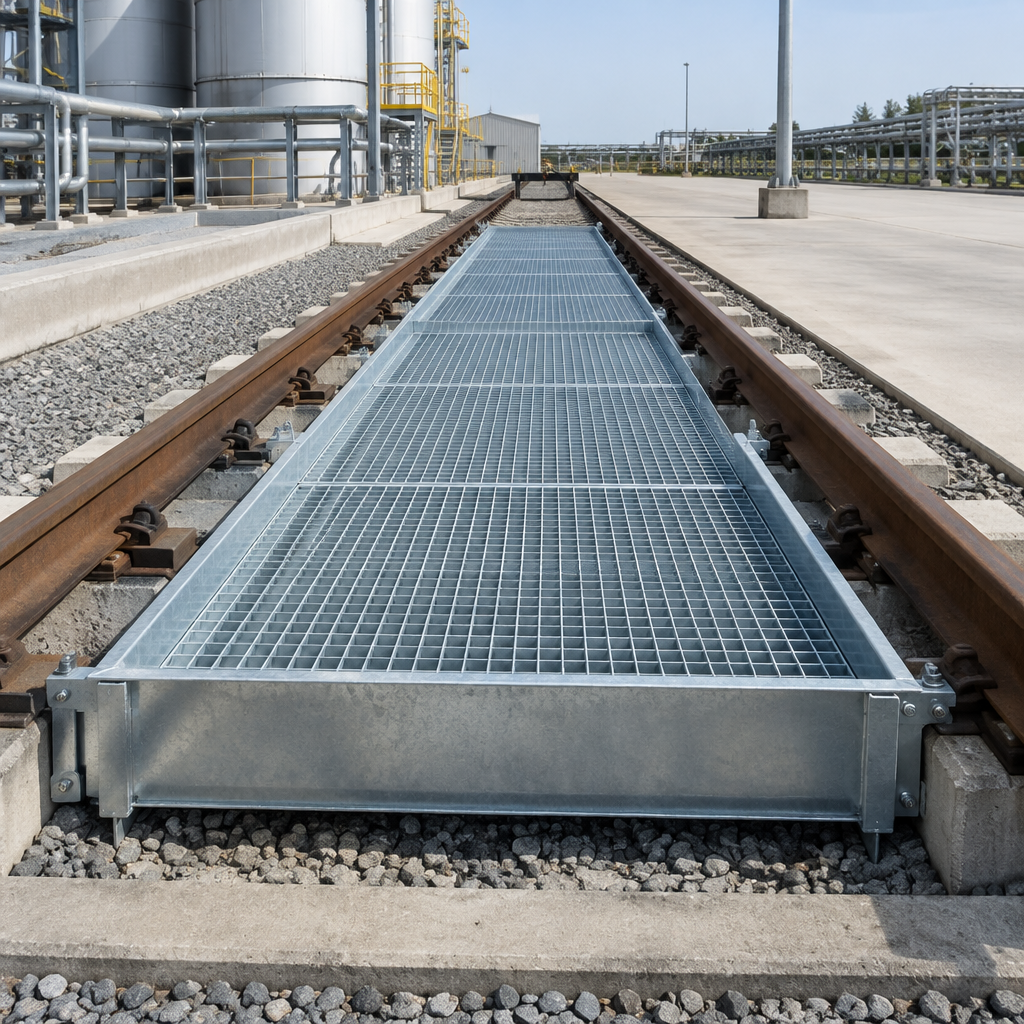
Track pans: steel or composite trays installed between and alongside rail tracks to catch product spilled during railcar loading, unloading or sampling. The pan follows the rail geometry, uses the track itself as part of the structure, and drains to a sump or a collection point. Essential at any facility handling rail tank cars.
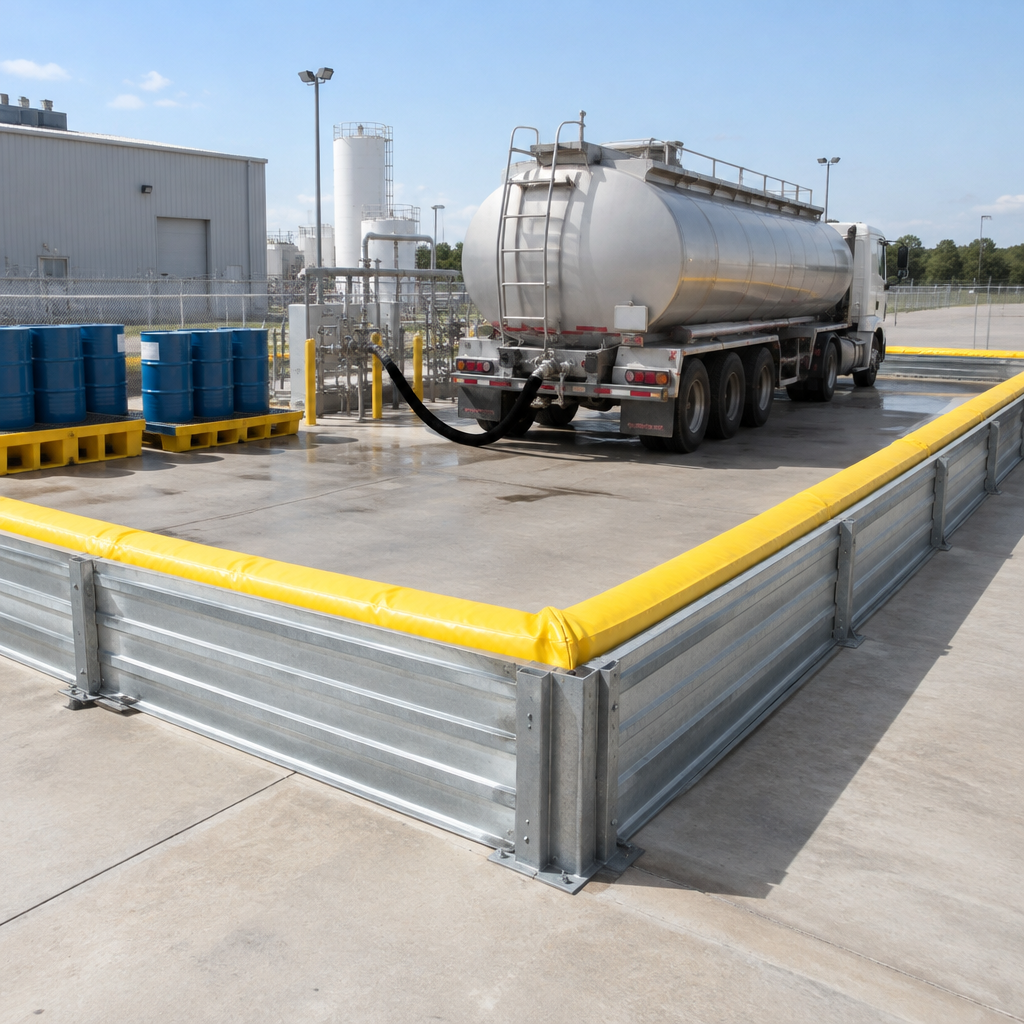
Drive-in containment berms: a bunded area that a road tanker can drive into and out of, built from steel panels or flexible foam barriers with a liner. The berm catches leakage during transfer, hose failure and tanker discharge incidents, and is the standard for truck loading bays and mobile refuelling points.
Drum and IBC spill pallets: a low platform with a sump under the container, allowing a leaking drum or IBC to be moved or stored safely. Used in chemical stores, workshops, laboratories and anywhere containers are decanted.
Containment berms and liners for static plant: flexible or rigid bunding around transformers, generators, bulk storage tanks and chemical dosing areas, typically with a liner and a drainage valve.
Capacity Rules and How They Are Applied
The governing principle in most jurisdictions, and in the guidance applied in Qatar, is that the containment volume must accommodate the largest credible release plus an allowance for rain and fire water. The common formulations:
- 110 percent of the largest single container: the standard rule for drum storage and IBC pallets
- 110 percent of the largest tank, or 25 percent of the total stored volume, whichever is greater, for bulk tank bunding
- Rain allowance: in Qatar this is often treated as negligible by suppliers, which is a mistake. The occasional intense rainfall event fills open bunds quickly, and a bund that is full of rainwater has no capacity when it matters
- Fire water allowance: where the fire strategy involves foam or water application, the bund may need to hold the fire water as well. This is a design coordination point, not a product selection point
Applying these rules to a specific site is what separates a compliant installation from a catalogue purchase. A pallet sized for the drum that sits on it is compliant. A bund sized to the average tanker load, rather than the largest compartment, is not.
Materials and Construction for Gulf Conditions
- Hot-dip galvanised steel to ISO 1461: the default for track pans, berm walls and rigid bunding. Strong, repairable and effective in heat
- Polyethylene: the standard for spill pallets and IBC sumps. Chemically resistant, UV stabilised grades essential in Qatar, and structurally limited on load, so the load rating against the actual filled weight matters
- Flexible PVC or polyurethane liners: used inside berms and bunds. UV and hydrocarbon resistance are the two selection criteria that decide whether the liner survives five summers
- Foam containment barriers: the drive-in, drive-over solution for mobile operations. Fast to deploy, and dependent on the foam quality and the liner underneath
- Grating and decking: galvanised or fibreglass grating over the sump, with a load rating to suit the traffic and a surface that can be cleaned of sand
- Valves and drainage: a contained, lockable drain valve per bund, normally closed, with the key controlled under a procedure. A bund with an open drain is a funnel, not containment
Detailing That Decides Whether Containment Works
- Set the containment below the hazard, with the fill point and the vent inside the bunded area, because most releases happen at the connection, not in the tank
- Allow for the hose: the transfer hose and coupling must sit within the containment footprint, which means the bund is usually larger than the tank
- Grade the floor so the sump is at the low point and the whole volume drains to it
- Keep rainwater out with covers, roofs or a management procedure, and provide a documented method for emptying clean rainwater
- Protect the liner at vehicle entry points with a drive-over ramp or a reinforced apron, otherwise the first tanker that arrives punctures it
- Provide a sump of adequate depth for the pump or vacuum truck to recover the product
- Keep incompatible containers apart inside the same bund, and label the area
- Anchor against wind and vehicle impact, because an empty berm wall is a sail and a loaded one is a target
- Integrate with the fire and foam system, so the containment volume accounts for extinguishing media
- Record the capacity in litres on a plate attached to the frame, and keep the calculation with the as-builts
Standards and Regulatory Context
- Qatar environmental requirements: the Ministry of Environment and Climate Change regime governing storage, handling and spill response, together with the environmental impact assessment conditions attached to the facility's permits
- QCS 2014: Qatar Construction Specifications for the civil works, drainage and materials surrounding containment areas
- NFPA 30 and NFPA 30A: flammable and combustible liquids codes, which set the bunding and separation philosophy at fuel facilities
- SPCC style practice: the US spill prevention methodology, widely used as an engineering reference by consultants in the Gulf for capacity calculations
- ISO 14001: the environmental management framework many Qatari operators now work to, which makes the containment inspection regime an auditable process rather than a maintenance task
- EN 1991 and EN 1993: where the berm is a steel structure, the loads and design follow the structural Eurocodes
Maintenance and Inspection
Containment fails quietly. A routine that catches it early is short:
- Monthly: visual inspection of the sump for accumulated product or rainwater, check the drain valve is closed and locked, inspect the liner and seals
- Quarterly: clear sand and debris from gratings and sumps, check the foam barrier for UV damage, verify the load plates and labels
- Annually: full integrity check of the structure and liner, capacity review against the current inventory, confirm the drain valve procedure is still understood by the operators
- After any spill or alarm: the bund is emptied, inspected and released back to service with a record
Sand is the specific Gulf complication. It fills sumps, blocks recovery pumps and hides the low point that everything was designed to drain to. A scheduled blowdown and clean is not optional housekeeping, it is part of keeping the containment functional.
Frequently Asked Questions
How much containment volume do I need for drum storage?
A common and widely accepted rule is 110 percent of the largest container in the group, with the containment sized so that a failure of the largest single drum or IBC is fully captured. Always confirm against the project's own environmental requirements and the consultant's calculation.
Are track pans required at every rail loading point in Qatar?
Where rail tank cars are loaded, unloaded or sampled, containment at the connection is standard practice and is generally expected by both the operator's environmental permit and its own spill prevention plan. The extent of the panning follows the drainage and the risk assessment.
Galvanised steel or polyethylene for spill containment?
Galvanised steel for track pans, berm walls and load bearing structures. Polyethylene for pallets and sumps where chemical resistance matters and loads are lower. UV stabilised grades are essential in Qatar for anything plastic exposed to sun.
Can a spill berm be mobile?
Yes. Foam barrier and liner systems are designed to be deployed and recovered, which suits temporary works, mobile refuelling and sites where the layout changes. A mobile berm needs a documented deployment procedure and staff who have practiced it.
How do I stop rainwater filling the bund?
Cover it where possible, grade the floor to a drainable sump, and maintain a documented procedure for emptying clean rainwater under supervision. The common failure is a bund left full of dirty rainwater with a closed valve and no owner.
Conclusion
Secondary containment is a small line item that protects a very large liability. The products are straightforward, the engineering is not complicated, and the failure modes are well known: undersized volume, an open drain, a punctured liner at the vehicle entry point, and a sump full of sand when it is needed.
For projects in Qatar, size the containment to the largest credible release with a rain and fire water allowance, specify galvanised steel or UV stabilised polyethylene for the climate, put the drain valve under a documented procedure, and integrate the containment with the fire strategy and the site drainage. Then inspect it monthly, because containment only exists in the moment it is needed.
Post a detailed inquiry on Kinetic to receive quotes from verified suppliers of spill containment, track pans and containment berms in Qatar, or get a contact directly from SRG.
Source spill containment systems, track pans and bunded storage on Kinetic.
Related Articles

Dock Equipment in Qatar: Levelers, Vehicle Restraints and Loading Bay Safety
31 Oct 2026

Fall Protection at Loading Bays in Qatar: Safety Gates, Handrails, Lifelines and Harnesses
31 Oct 2026

Safety Showers and Eyewash Stations in Qatar: ANSI Z358.1, Tepid Water and Compliance
31 Oct 2026Looking for materials?
Post an inquiry on the Kinetic marketplace and connect with verified suppliers across the Gulf.