

Gas Tight Doors, Blast Valves and Blast Resistant Doors: Attack and Gas Protection for Critical Facilities in Qatar
Some buildings must do more than keep weather out. Control rooms, shelters, laboratories, energy facilities and high security rooms must keep out radioactive particles, bio hazardous material, industrial by-products, toxic gas infiltration and even the pressure wave of an explosion. The weakest points in that envelope are always the same: the doors and the ventilation path.
This guide explains the family of attack, blast and gas protection products: gas tight and air tight doors, blast valves, blast resistant doors, RF attack resistant doors and post installation pressure testing. It covers what each component does, the threats it addresses, and how to specify and source this equipment for critical facilities in Qatar and the GCC.
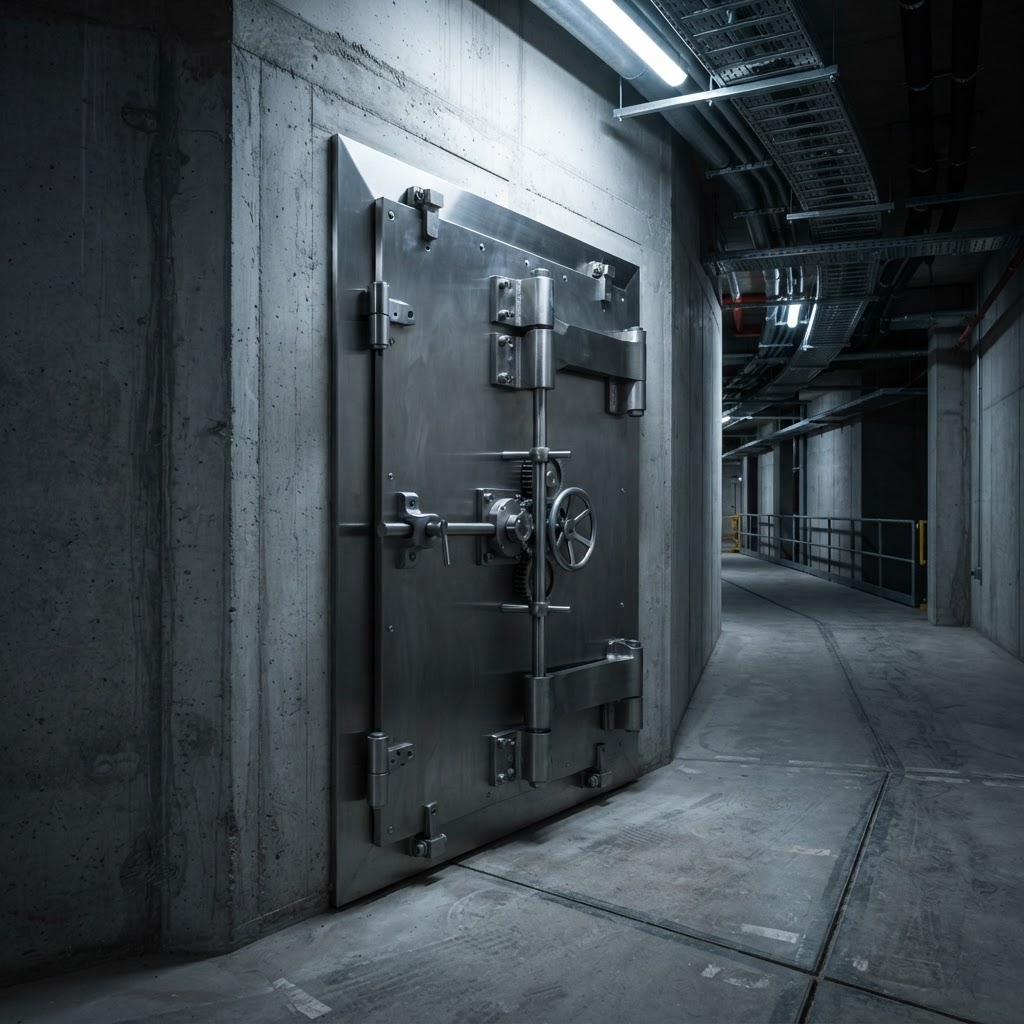
The Threats These Products Address
Protective doors and valves are engineered against a specific threat list:
- Toxic and industrial gas infiltration: chemical by-products, industrial gases and hazardous vapours entering an occupied space
- Radioactive contamination: airborne radioactive particles reaching personnel areas
- Bio hazardous material: biological agents crossing the room boundary
- Blast overpressure: the pressure wave from conventional explosives travelling through the structure or the ventilation system
- Electromagnetic threats: electromagnetic pulse (EMP) and ionising radiation effects on sensitive electronics
- Physical attack: forced entry attempts on security rooms and high value spaces
No single product covers the whole list. A protected facility combines a sealed door, a protected ventilation path and a tested assembly, all matched to the design threat.
Gas Tight and Air Tight Doors
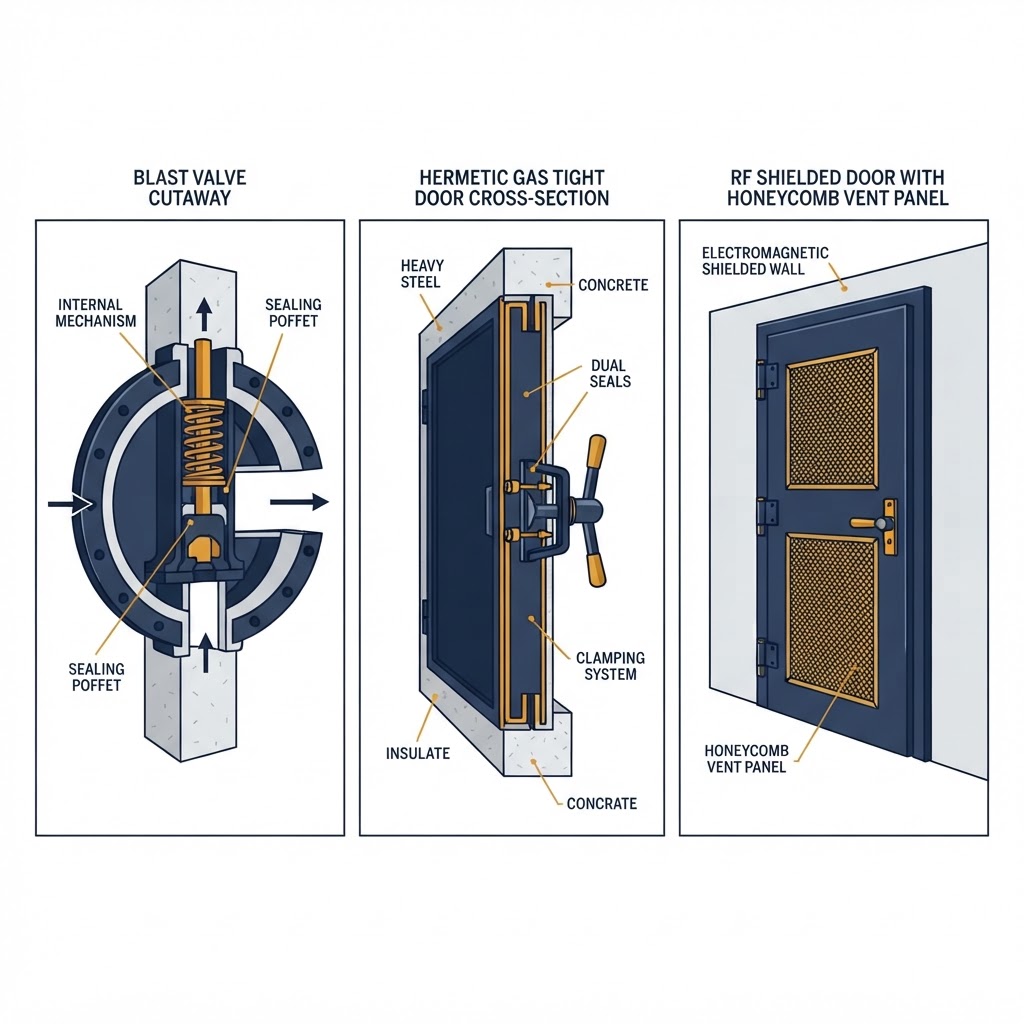
Gas tight doors (also called air tight or hermetic doors) are designed to seal a room so completely that gases, vapours and airborne particles cannot pass the door line. Specialist manufacturers build them for nuclear, pharmaceutical, laboratory and industrial applications, where they protect against radioactive material, bio hazardous substances and industrial by-products.
The engineering is in the details:
- Sealing system: continuous gasket seals compressed uniformly around the full door leaf, often inflated or clamped, so there is no leak path
- Leaf and frame: stiff steel construction that resists deflection under pressure differential, because a warped frame breaks the seal
- Hardware: pressure rated locking mechanisms that keep the leaf loaded against the seal under both positive and negative pressure
- Performance verification: air tightness is a measurable quantity, which is why specialist manufacturers offer post installation pressure testing
Gas tight doors are specified in pairs with air locks or transfer hatches when a facility needs an unbroken seal with people still moving in and out.
Blast Valves
A blast valve protects the ventilation system, the one path that always penetrates the protective envelope. In normal operation, air flows freely for ventilation. When a pressure wave arrives, the valve shuts in milliseconds and blocks the wave from entering through the duct.
Key characteristics:
- For high airflow applications: blast valves are used where a large airflow is required, so ventilation capacity does not have to be sacrificed for protection
- Both directions: they are suitable for both inlet and exhaust air, protecting the duct in either configuration
- Forms: circular and rectangular pattern valves exist to match duct geometry, in a range of sizes
- Applications: civil defence shelters, refuge rooms, control rooms, tunnels and any protected space that must stay ventilated after an event
Without a blast valve, the best sealed door is defeated by the duct behind the wall. Protected facilities therefore treat doors and ventilation protection as a single system.
Blast Resistant Doors
Blast resistant doors are engineered to withstand the pressure and impulse loading of an explosion while keeping the opening closed afterwards. The blast door product family also extends into specialised versions:
- Conventional blast doors: heavy steel assemblies rated against blast overpressure, closing the wall opening of a shelter or protected room
- EMP protective doors: doors that provide electromagnetic pulse protection, shielding electronics and control systems inside
- Ionising radiation shielding doors: doors with radiation attenuating construction, used in radiological facilities and shielded enclosures
- Gas infiltration resistant versions: doors that combine blast resistance with sealing against gas ingress
The door is normally supplied as a tested assembly: leaf, frame, hinges and locking hardware rated together, because a strong leaf in a weak frame does not stay closed.
RF Attack Resistant Doors
A newer category addresses both physical and electronic attack. RF attack resistant doors combine:
- Physical security: manufactured to the LPS 1175 security rating scheme at the D10 (SR4) level, the established UK standard for forced entry resistance of doors and shutters
- RF shielding: shielded versions prevent radio frequency signals from crossing the door line, protecting secure rooms, SCIF style facilities and sensitive equipment against eavesdropping and RF attack
- Practical sizing: available in a range of sizes, for example from minimum openings around 1633 mm high by 326 mm wide up to a maximum of around 2400 mm high by 1176 mm wide, with RF shielded versions across the range
Pressure Testing: Proving the Seal
A gas tight door is only as good as its installed condition. Frame alignment, seal compression and hardware adjustment on site can all degrade a door that left the factory perfect. That is why specialist manufacturers offer post installation gas tight door pressure testing:
- Testing is performed to a recognised test method (one specialist manufacturer cites the BS EN 1023:2016 test method) or to the client's own acceptance criteria
- Testing verifies leakage rate under pressure differential, the true measure of a gas tight assembly
- The test produces documentation that the facility can keep for audit, commissioning and handover
For a facility whose safety case depends on a sealed boundary, an untested door is an unverified assumption. Owners should budget for pressure testing as part of commissioning, not as an optional extra.
Why This Matters for Qatar and the GCC
Qatar's critical infrastructure programme creates sustained demand for protective construction products:
- Energy and industrial facilities: control rooms, shelters and safe havens in oil, gas and petrochemical plants, where toxic release scenarios drive both gas tight and blast requirements
- Government and defence facilities: protected rooms, shelters and security spaces built to physical security and EMP aware criteria
- Data centres and secure rooms: RF shielded spaces where electronic attack and eavesdropping are part of the threat model
- Tunnels and metro environments: ventilation paths that need blast protection in underground infrastructure
- Laboratories and healthcare: containment areas that must remain sealed under pressure differential
For trading companies and suppliers in Qatar, this is a specialised import category: products are engineered to order, certified against named standards (for example LPS 1175), and they reach projects through specification rather than off the shelf sale. That makes early engagement with the design team and complete documentation the difference between winning and losing the supply.
Specifying Gas Tight and Blast Protection: A Practical Checklist
- Define the design threat first: gas infiltration, blast overpressure, radiation, EMP or forced entry, because each drives a different product
- Specify tested assemblies: leaf, frame and hardware rated as a complete unit, not individual components
- Name the standards: security ratings such as LPS 1175 SR4, and the applicable test method for gas tightness
- Coordinate with the ventilation engineer: blast valves must match the duct sizes, airflow and the blast load case
- Plan for penetrations: every duct, cable and pipe crossing the protected boundary needs a sealed or protected detail
- Include pressure testing in the scope: post installation gas tightness testing with documented results for handover
- Check installation requirements: these doors are heavy, and frames need correct embedment, alignment and wall construction to perform
- Demand full documentation: material certificates, test reports, rating certificates and installation instructions for the submittal and the facility file
- Plan service access: seals, gaskets and hardware are wear items, and replacements should be identified before handover
Frequently Asked Questions
What is a gas tight door?
A hermetically sealed door that prevents gases, vapours and airborne particles from crossing the door line. It is used against radioactive material, bio hazardous substances and industrial by-products, and its performance is verified by pressure testing.
What is an air tight door used for?
Air tight doors seal a room against air leakage, maintaining pressure differentials and contamination control in laboratories, clean spaces, shelters and industrial facilities.
What does a blast valve do?
A blast valve lets ventilation air flow through a duct in normal conditions and closes almost instantly when a pressure wave arrives, stopping the blast from entering the protected space through the ventilation path. It suits high airflow applications and both inlet and exhaust air.
How is a blast resistant door different from a security door?
A blast resistant door is rated against explosion overpressure and impulse, keeping the opening closed during and after an event. A security door is rated against forced entry, for example to LPS 1175. RF attack resistant doors combine both properties with RF shielding.
What is LPS 1175 SR4?
LPS 1175 is the UK certification standard for the physical security of doors, shutters and windows, with security ratings (SR grades) that describe the tools and time an attacker is assumed to have. SR4 is a high grade in the scheme, suitable for high security applications.
Do gas tight doors need testing after installation?
Yes. Site installation can degrade factory performance, so specialist manufacturers offer post installation gas tight door pressure testing to a recognised test method or to client acceptance criteria, producing the documentation the facility needs at handover.
Where are these products used in Qatar?
Oil, gas and petrochemical control rooms and shelters, government and defence facilities, data centres and secure rooms, tunnels and metro infrastructure, and laboratory containment areas.
Can one door do everything?
Some product families combine properties: blast resistant doors are available with EMP protection, ionising radiation shielding and gas infiltration resistance, and RF attack resistant doors combine LPS 1175 SR4 security with RF shielding. The correct combination depends on the design threat, so early specification is essential.
Conclusion
Attack, blast and gas protection is a systems discipline. The door, the valve, the frame and the test are one protective boundary, and each component must be matched to a clearly defined threat. For critical facilities in Qatar, the practical path is to define the threat early, specify tested assemblies against named standards, coordinate the ventilation protection and verify the installed result by pressure testing.
Post a detailed inquiry on Kinetic to receive quotes from verified suppliers of gas tight doors, blast valves and protective construction products, or get a contact directly from SRG.
Source protective doors and blast protection equipment on Kinetic.
Related Articles


Spill Containment in Qatar: Track Pans, Berms, Pallets and Secondary Containment
31 Oct 2026
Dock Equipment in Qatar: Levelers, Vehicle Restraints and Loading Bay Safety
31 Oct 2026

Fall Protection at Loading Bays in Qatar: Safety Gates, Handrails, Lifelines and Harnesses
31 Oct 2026Looking for materials?
Post an inquiry on the Kinetic marketplace and connect with verified suppliers across the Gulf.