

Fall Protection at Loading Bays in Qatar: Safety Gates, Handrails, Lifelines and Harnesses
Falls remain the leading cause of fatal injury in industrial work worldwide, and the loading bay is one of the places where they happen most often. The reason is not recklessness. It is that the work itself pulls people toward an edge: reaching a hatch, connecting a coupling, checking a dome, throwing a tarp over a load. Each of those tasks puts a person's weight in the wrong place for a second or two, and a second is enough.
Fall protection is a hierarchy, not a product. This guide sets out the order in which the measures should be applied, the components that belong on a loading structure, the standards to reference in a Qatar specification, and the inspection regime that keeps the equipment usable.
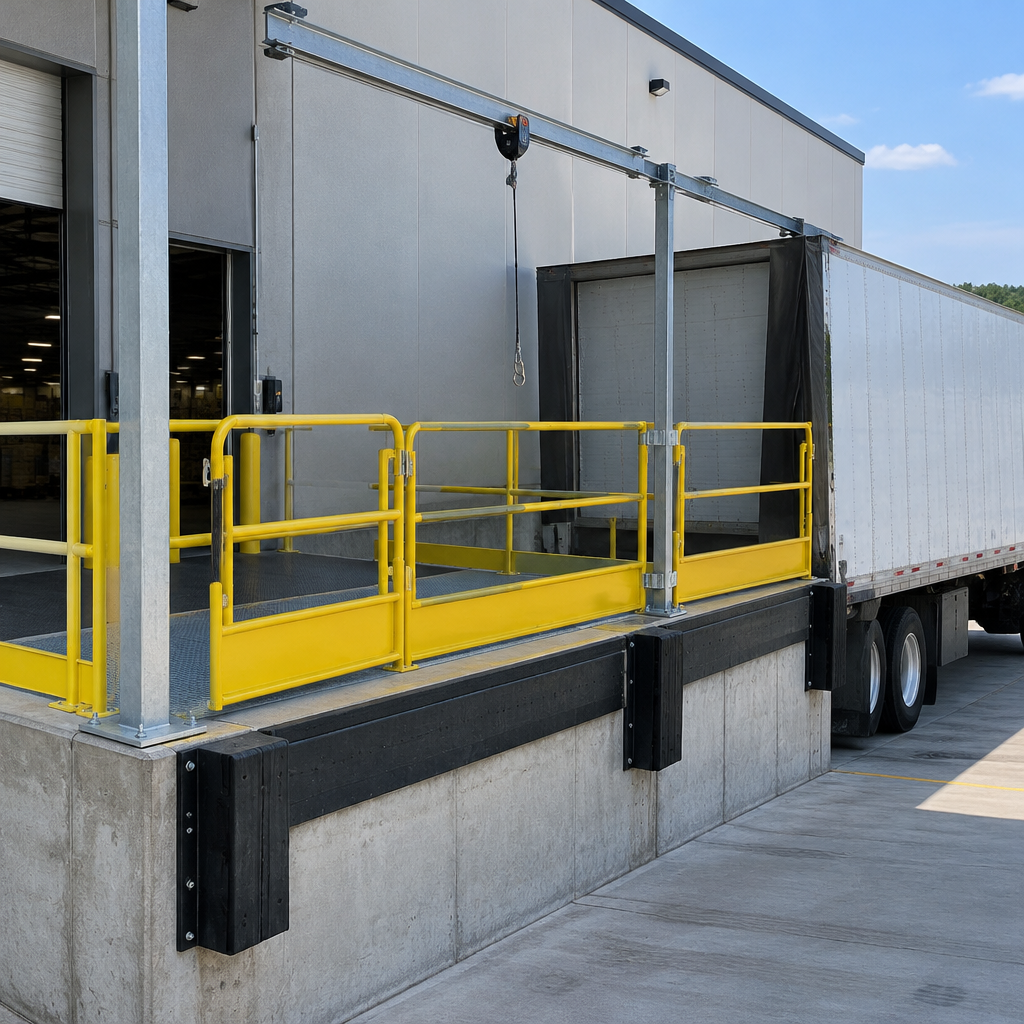
The Hierarchy of Control
The sequence is fixed and each step removes more risk than the one after it:
1. Eliminate the task. Can the operation be done from ground level, with a longer hose, a remote valve or an automatic sampler? Every elimination removes the fall and the equipment.
2. Passive protection. Guardrails, self-closing gates, toe boards and fixed platforms. These work without the worker doing anything, which is why they outperform everything else. A handrail never forgets to clip on.
3. Restraint. A system that prevents reaching the edge at all, such as a fixed short lanyard that keeps the worker inside a safe zone. Restraint is preferred to arrest because there is no fall to arrest.
4. Fall arrest. A harness, lanyard and anchor that stop a fall after it starts. This is the last line, and it depends on the worker wearing it correctly, the anchor being rated, and the rescue being planned.
5. Administrative controls. Training, permits, signage and supervision. Necessary, and never sufficient on their own.
Most incidents at loading facilities trace back to a site that relied on step 5 because steps 2 and 3 were value engineered out.
Passive Protection: Where the Money Goes First
Self-closing safety gates belong at every platform edge and every access opening. The gate closes behind the user under spring tension or gravity, so the gap cannot be left open. Specify a gate that closes from any position and has no latch that requires deliberate operation.
Handrails should be continuous around the platform at roughly 1100 mm height, with a mid-rail and a toe board. The loading side deserves particular attention: it is where operators lean toward a vehicle, and it is the side most often left open for "access".
Gaps and openings. A hatch left open, a removed grating, a missing toe board: all are holes in the system. Where an opening must stay open for the process, it needs a fixed guardrail or a removable rail with a positive reminder, never a cone.
Tarping and flatbed access is a specific case. Drivers climb onto flatbeds to secure loads and throw tarps, and that surface has no rails at all. Platform-based tarping systems, or a gantry that lets the tarp be handled from a protected position, remove the task from the load surface entirely.
Fall Arrest Systems: Choosing Between Cable, Rail and SRL
Where passive protection is impractical, the arrest system has to be designed:
Overhead rigid rail with a travelling trolley is the most comfortable option and the one increasingly specified for loading gantries in Europe and the Gulf. The user clips in and walks; the trolley follows and locks on a fall. Little to no fall distance, no swing hazard.
Horizontal cable lifeline systems are cheaper and easier to retrofit across a long gantry, but they deflect under load, which increases the fall distance and requires the anchors to be engineered for the resultant forces. The deflection and the number of users per span are design inputs, not details to leave to the supplier.
Self-retracting lifelines on fixed anchors give short fall distances and suit a single work position. They need the correct class for the application and a defined rescue plan.
Vertical systems for fixed ladders, covered in our guide to fixed and ship ladders in Qatar, follow the same logic for a different geometry.
The clearance calculation is where most installations go wrong. The fall distance is the lanyard length plus deceleration distance plus the height of the anchor relative to the worker plus a safety margin, and if the calculated arrest point is below the floor, the system does not work. This calculation belongs in the design, signed by an engineer, not estimated on site.
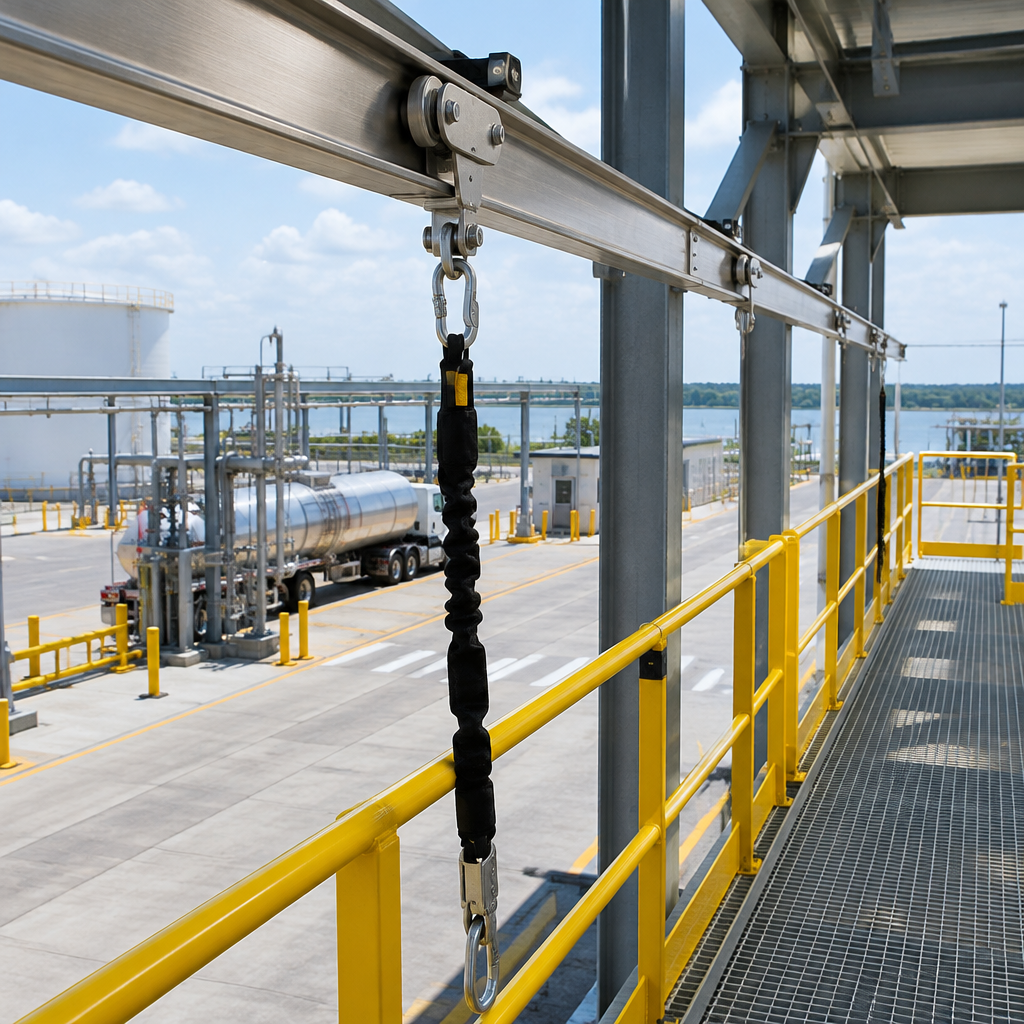
Harnesses, Lanyards and the Human Factors
The best system fails if the person does not wear it correctly. The practical requirements:
- Full body harness with a dorsal attachment point for arrest, inspected before each use and formally every six months by a competent person
- Lanyard with an energy absorber for arrest, or a restraint lanyard where the intent is restraint
- A documented rescue plan. Suspension trauma can become life threatening within 15 to 20 minutes, so "call someone" is not a plan. Who recovers the casualty, with what equipment, and how quickly?
- Training that includes a practical suspension exercise, not only a classroom session
- A register of equipment with serial numbers and inspection dates, kept where the equipment is issued
In Qatar the heat adds a factor that specifications often ignore. A harness worn over light clothing in 45 degrees becomes uncomfortable within minutes, and discomfort is the main reason workers unclip. Shade at the loading position, hydration and a rotation policy are part of the fall protection system in practice, whatever the drawing says.
Standards for a Qatar Specification
- EN 363: personal fall arrest systems, the framework for the assembly
- EN 361: full body harnesses
- EN 355: energy absorbers and lanyards
- EN 353-1 and EN 353-2: guided type fall arresters on rigid and flexible anchors
- EN 795: anchor devices, including the classes for structural and temporary anchors
- EN 365: general requirements for use, maintenance and periodic inspection of personal protective equipment
- EN ISO 14122-3 and -4: guardrails and fixed ladder protection
- OSHA 1910.28 and 1910.29: duty to provide fall protection and the criteria for guardrail systems, common in US derived specifications
- QCS 2014 and Qatar HSE requirements: Labour Law 14 of 2004 and the associated ministerial provisions, plus the facility's permit to work system
Design Details Worth Getting Right
- Anchor points above the user, so the fall distance is short and there is no swing hazard
- Anchor ratings that account for the number of simultaneous users and the system dynamics
- A gate at every opening, closing automatically, tested daily
- Guardrails continuous except where a gangway docks, and closed automatically when it does not
- No gap between the platform and the vehicle that a foot can find
- Lighting at the fall edge, because most tarping and sampling happens early or late
- A rescue kit near the access point, not in a store 200 metres away
- Signage showing the anchor use, the maximum users per system and the inspection date
- Integration with the loading access structure, since the access and the protection are one design, as set out in our guide to loading access platforms in Qatar
- A written inspection regime with named responsibility, because equipment without an owner decays quietly
Inspection and Maintenance
- Before each use: harness and lanyard visual check by the user, recorded in the permit
- Monthly: gates, handrails, anchors and signage visual inspection
- Every six months: detailed PPE inspection by a competent person under EN 365
- Annually: structural check of the anchors and the fall arrest system, including the anchor pull test where required
- After any fall event: everything involved out of service, inspected and documented, no exceptions
Frequently Asked Questions
Is a handrail enough on a loading platform in Qatar?
Where the platform is complete, with continuous handrails, toe boards and self-closing gates at every opening, it provides the primary protection and is the preferred solution. Fall arrest is needed where the geometry or the task requires reaching beyond the protected zone.
Which is better, a rigid rail or a cable lifeline?
A rigid rail for comfort, short fall distances and heavy use. A cable system where the structure cannot take a rail or the budget is constrained, provided the deflection is engineered and the anchors are rated for it.
How often must harnesses be inspected?
A visual check before every use, and a formal detailed inspection by a competent person at least every six months, or more often in harsh conditions. In Qatar the heat and UV justify the shorter interval.
Do I need a rescue plan as well as the equipment?
Yes, and it is a specific requirement of any competent fall protection programme. A suspended casualty has minutes, not hours, so the rescue method and the people able to perform it must be defined before the system is used.
Can fall protection be retrofitted to an existing gantry?
Usually yes. The constraint is the structure: an anchor needs a rated fixing, and a cable system needs the supporting steel to take the load. A structural survey and a designed anchor detail come before any purchase.
Conclusion
Fall protection at a loading bay is a design problem before it is a purchase. Put the passive measures in first, handrails, gates and toe boards everywhere a person can stand near a drop, then engineer the arrest system where the task truly requires reaching out, then train and equip for the residual risk, and plan the rescue before anyone clips in.
For Qatar projects, specify to EN 363 and EN 795 with EN ISO 14122 for the structures, calculate the fall clearance rather than assuming it, buy equipment that comes with an inspection and rescue regime, and treat shade, hydration and comfort as part of the control measure. A harness that is too hot to wear is not protection, it is an intention.
Post a detailed inquiry on Kinetic to receive quotes from verified suppliers of fall protection systems, safety gates and lifelines in Qatar, or get a contact directly from SRG.
Source fall protection, safety gates and lifeline systems on Kinetic.
Related Articles


Spill Containment in Qatar: Track Pans, Berms, Pallets and Secondary Containment
31 Oct 2026
Dock Equipment in Qatar: Levelers, Vehicle Restraints and Loading Bay Safety
31 Oct 2026

Safety Showers and Eyewash Stations in Qatar: ANSI Z358.1, Tepid Water and Compliance
31 Oct 2026Looking for materials?
Post an inquiry on the Kinetic marketplace and connect with verified suppliers across the Gulf.