

Safety Showers and Eyewash Stations in Qatar: ANSI Z358.1, Tepid Water and Compliance
Chemical burns and eye injuries are among the few industrial injuries where the response in the first ten seconds determines the outcome. A safety shower or eyewash station is the equipment that makes that response possible, and in a Gulf climate it is also the equipment most likely to be installed, commissioned, and then quietly allowed to become unusable.
The reasons are specific to the region. Water sitting in an unshaded pipe reaches temperatures that will scald a casualty rather than help them. Dust blocks spray heads. Units installed in a corner behind a pallet stack are, in practical terms, not installed at all. This guide covers the standards to specify against, the tepid water problem, siting, commissioning and the weekly routine that keeps a unit working.
The Standards That Govern the Equipment
The reference standard for most of the world, and for most specifications in Qatar, is ANSI/ISEA Z358.1, which sets the performance and use requirements for emergency shower and eyewash equipment. EN 15154 is the European equivalent and appears on some European supplied projects. The core requirements are worth knowing because they are what an audit checks:
- A 15 minute flush at a controlled flow, which is the time needed to dilute and remove most chemical contamination
- Tepid water, defined as between 16 and 38 degrees Celsius. Below 16 the casualty will not stay under it long enough, above 38 there is a risk of scalding and further tissue damage
- Minimum flow rates, commonly around 76 litres per minute for a shower and around 1.5 litres per minute for an eyewash, delivered as a soft spray rather than a jet
- Hands free operation that stays on once activated, so the user can hold their eyes open with both hands
- Activation in one second or less, with a clearly identifiable handle or foot pedal
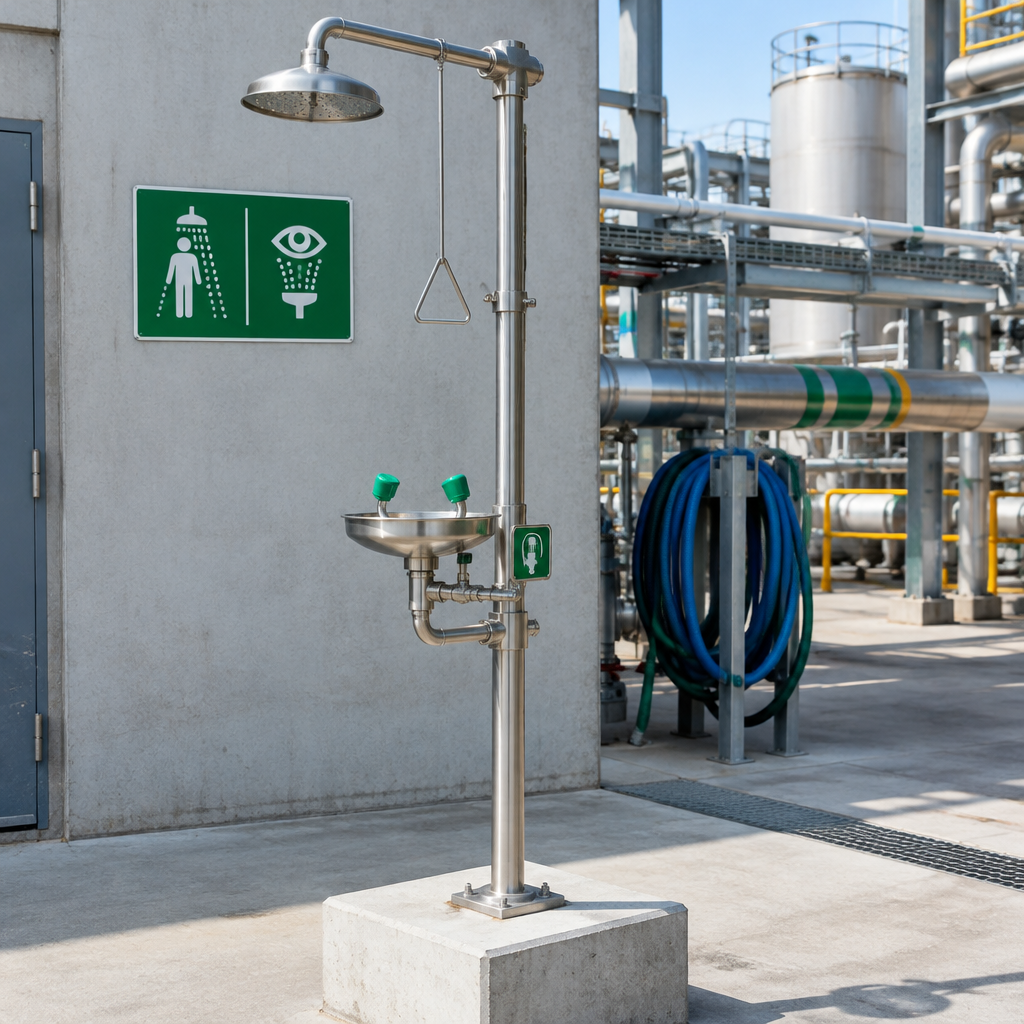
- Unobstructed access, within roughly 10 seconds of travel from the hazard, on the same level, with a clear path and visible signage
- Weekly activation to verify flow and flush the line, plus an annual inspection by a competent person
Types and Where Each Belongs
Combination shower and eyewash: the standard for chemical plants, tank farms, laboratories and any area where a splash to the body is possible. The shower head and the eyewash bowl share a supply, with the eyewash at a height that suits a seated or bent over user.
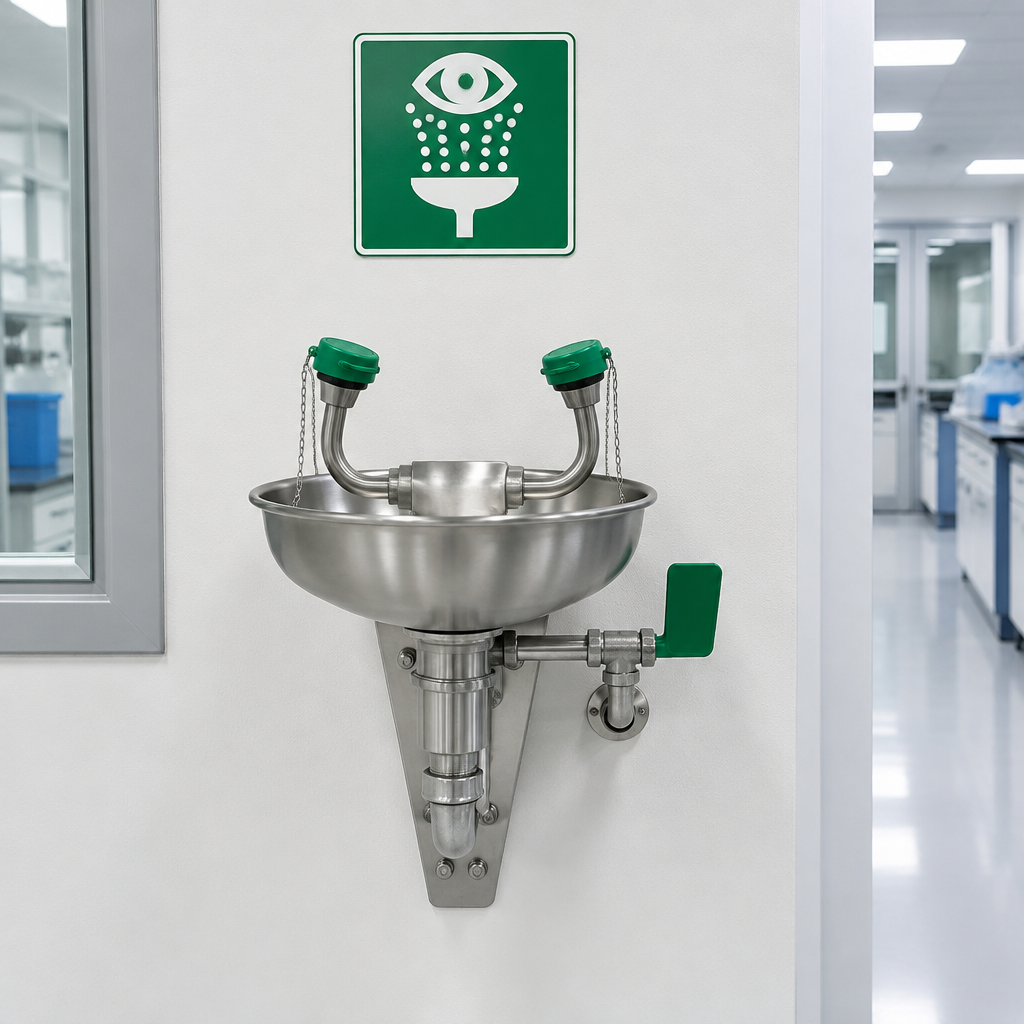
Eyewash only, wall or bench mounted: for laboratories and small chemical handling areas where a full body splash is unlikely. Wall mounted units save floor space, bench mounted units serve a specific work position.
Drench shower only: for areas where the body risk dominates, such as bulk chemical loading and tanker discharge points.
Portable and self contained units: for remote locations, temporary works and areas without a plumbed supply, including mobile tank units on construction sites. These need a maintenance regime of their own, and a portable unit that has not been refilled is worse than a sign.
Emergency tank showers: a tank with a heater and a chiller for sites without a reliable water supply. In Qatar these need careful specification, because a tank in direct sun is an effective solar heater, and without insulation and temperature control it will deliver water well above the ANSI limit.
The Tepid Water Problem in a Gulf Climate
This is the issue that separates a compliant installation in Qatar from a compliant installation on paper.
In summer, water in an exposed pipe, a roof tank or an unshaded dead leg can exceed 50 degrees Celsius. A casualty who activates a shower and receives 50 degree water will step out immediately, which defeats the purpose of the equipment entirely. The engineering answers:
- Keep pipe runs short and shaded, and avoid dead legs where water sits and heats
- Insulate and trace the supply line, with recirculation where the run is long, so tepid water is at the outlet when the unit is activated rather than after two minutes of flushing
- Use a thermostatic mixing valve on hot and cold supplies, set and locked to deliver within the ANSI window, with a failsafe that shuts off if the cold supply fails
- Chiller or tempered storage where a mixing valve cannot achieve the range, which is common where the cold water supply itself is warm
- Test with a thermometer, not by hand, during commissioning and at each annual inspection, and record the readings
A unit that has never been temperature tested has not been commissioned. This is the single most common non conformity found in Gulf facilities.
Siting: The Ten Second Rule
The equipment is only as good as its location. The practical requirements:
- Within roughly 10 seconds of travel from the hazard, on the same level, without stairs or doors in between
- Path clear of stored materials, pipework and vehicle routes, and marked so it stays clear
- Signage visible from the hazard area, using recognised symbols rather than text alone, because a casualty may not be able to read
- Not behind a door that opens inward, and not in a locked room
- Away from electrical panels and other hazards that would be affected by the water
- Positioned so the user is not exposed to the chemical source, typically upwind and out of the splash zone
- Drainage to take a 15 minute full flow flush. A unit that floods the area will be turned off or sandbagged, which defeats it
- Consideration of modesty for full body showers in exposed areas, without blocking access
- Lighting that allows use at night
- Accessible height and operation for wheelchair users where the area is accessible
Materials and Construction for the Climate
- Stainless steel 304 or 316: the default for plant and laboratory environments. Grade 316 in coastal and chemical exposure
- Powder coated galvanised steel: acceptable in dry inland areas, but the coating will chip and the substrate will corrode if it is not maintained
- PVC and plastic bowls: used on some eyewash units, adequate if UV stabilised, and they avoid corrosion entirely
- Spray heads and strainers: removable for cleaning, with dust covers that are pushed off by the water flow. In Qatar the dust covers are essential, not optional
- Valves and fittings: corrosion resistant with a stainless or bronze ball valve, and a stay-open mechanism that does not rely on a spring that will fatigue
- Signage: UV stable, photoluminescent where night visibility matters
Commissioning, Testing and the Weekly Routine
Commissioning should produce a record, not just a working unit:
- Flow rate measured at the shower head and the eyewash, against the standard's minimums
- Temperature measured and recorded, within the tepid range, and again after a two minute flush
- Activation time and stay-open function verified
- Drainage verified at full flow for the duration of a 15 minute flush
- Signage and path marking in place, and the location entered in the site emergency plan
The ongoing routine:
- Weekly: activate every unit and confirm flow and temperature, recorded on a tag at the unit. This is the requirement, not a suggestion
- Monthly: clean spray heads and strainers, check for leaks and corrosion
- Annual: full inspection by a competent person, temperature and flow verification, sign off and record
- After any use: the unit goes back into service only after inspection, and the incident is recorded
Frequently Asked Questions
What temperature must emergency shower water be in Qatar?
ANSI Z358.1 requires tepid water between 16 and 38 degrees Celsius. In Qatar the practical risk is water that is too hot, not too cold, so shading, insulation, recirculation and a thermostatic mixing valve are usually necessary to achieve compliance.
How far can a safety shower be from the hazard?
The accepted guidance is that the unit should be reachable within about 10 seconds of travel, which normally means within 15 to 20 metres, on the same level, with no obstruction. Closer is better.
Is weekly activation really required?
Yes. ANSI Z358.1 requires weekly activation to verify operation and to flush stagnant water from the line. In a Gulf facility this also removes the water that has been sitting hot in the pipe, so the first flush after activation delivers usable water.
Do I need a safety shower or just an eyewash?
It follows the risk assessment and the safety data sheet. Handling of corrosives and large volumes of chemicals normally requires a combination unit. Small volume laboratory work may justify an eyewash only, but the decision should be documented, not assumed.
Can a portable unit replace a plumbed shower?
For temporary works and remote locations, yes, provided it is maintained, filled and temperature checked. On a permanent facility the plumbed unit is the standard, and a portable unit is a supplement rather than a substitute.
Conclusion
Emergency shower and eyewash equipment is inexpensive, simple, and frequently unserviceable when it is needed. In Qatar the three failure modes are predictable: water that is too hot, heads blocked with dust, and a unit that has been quietly surrounded by stored material.
The fix is specification and routine rather than capital spend. Specify to ANSI Z358.1 or EN 15154, insist on a thermostatic mixing valve set within the tepid range, test the temperature with an instrument and record it, position the unit within ten seconds of the hazard with a clear marked path and real drainage, and put the weekly activation on the same paperwork as the rest of the site safety checks. Then it will work on the day it is needed, which is the only day that counts.
Post a detailed inquiry on Kinetic to receive quotes from verified suppliers of safety showers, eyewash stations and emergency equipment in Qatar, or get a contact directly from SRG.
Source safety showers, eyewash stations and emergency safety equipment on Kinetic.
Related Articles


Spill Containment in Qatar: Track Pans, Berms, Pallets and Secondary Containment
31 Oct 2026
Dock Equipment in Qatar: Levelers, Vehicle Restraints and Loading Bay Safety
31 Oct 2026

Fall Protection at Loading Bays in Qatar: Safety Gates, Handrails, Lifelines and Harnesses
31 Oct 2026Looking for materials?
Post an inquiry on the Kinetic marketplace and connect with verified suppliers across the Gulf.